

Quick answer: A tension headache feels like a tight band or pressure on both sides of your head, face or neck. It is very common, and the NHS says it is not a sign of an underlying condition. Painkillers, relaxation, better sleep and gentle exercise often help. See your GP if the headaches come several times a week or are severe. Physio Performance in Drogheda can check your neck, posture and movement.
Most people have had one. It can spoil a workday, but it is usually not serious. Still, it helps to know what is normal, what you can do at home and when to ask for help.
About 1,600 people in Ireland search for tension headache every month, according to Ubersuggest, and the number has stayed high through the year. This guide uses NHS advice, which we read in full on 11 November 2026, and adds the view of a physiotherapy clinic on the neck and shoulder side.
It is general information and not a diagnosis. See your GP about your own headaches. It is written by the Physio Performance team in Drogheda.
Key takeaways
- A tension headache is a pressing or tightening pain on both sides of the head, face or neck, and it is not a sign of an underlying condition, according to the NHS.
- Common causes are stress, sleep problems and caffeine. Taking painkillers too often can also cause headaches.
- You can usually ease it with painkillers, relaxation, exercise, better sleep and heat or cold on a sore neck.
- See your GP if headaches come several times a week, are severe or painkillers do not help.
- A physiotherapist can check your neck, posture and movement and give you an exercise plan.
Physio Performance, Donore Business Park, Drogheda. Free parking.
What is a tension headache?
A tension headache is the most common type of headache. The NHS describes it as pain on both sides of your head, face or neck. It often feels like something is pressing on your head or being tightened around it. The area may feel tender, and the pain may be worse when you touch it.
You can usually carry on with daily activities. That is one way to tell it apart from a migraine, which often makes everyday activity harder.
What does a tension headache feel like?
The usual signs are these.
- A dull, pressing or tight feeling, not a sharp stab.
- Pain on both sides of the head, face or neck.
- A tender scalp or neck when touched.
- Pain that lasts at least 30 minutes and can last much longer, sometimes for several days.
- Daily activities are still possible, even if you feel uncomfortable.
Source: NHS, Tension headaches.
What causes tension headaches?
The NHS lists these common causes.
- Stress.
- Sleep problems.
- Caffeine.
- Taking painkillers for headaches too often or for a long time. These are called overuse or rebound headaches.
The NHS also says they are not a sign of an underlying condition. That is reassuring, but it does not mean you should ignore a pattern. If they keep coming back, speak to your GP.
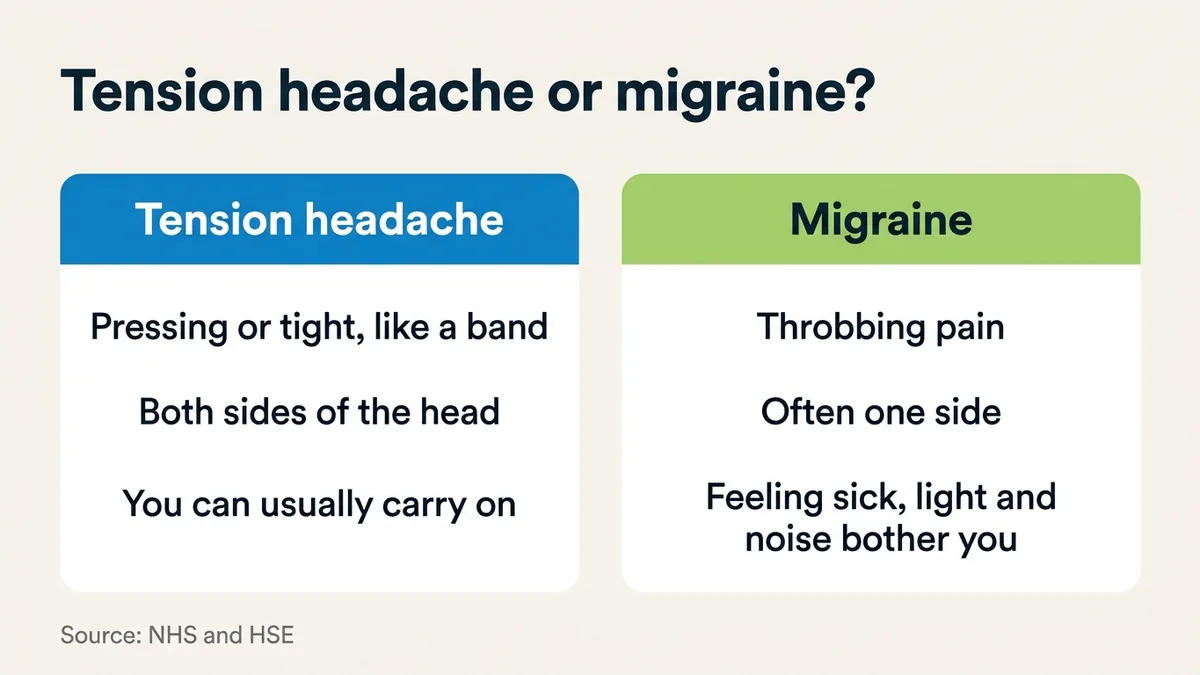
Is it a tension headache or a migraine?
The difference matters, because migraine and tension headache are treated differently.
| What you notice | Tension headache | Migraine |
|---|---|---|
| Type of pain | Pressing or tight, like a band | Throbbing |
| Where | Both sides of the head, face or neck | Often one side, or the front |
| Other signs | You can usually carry on with your day | Feeling sick, light or noise bothers you |
Sources: NHS, Tension headaches, and HSE, Migraine overview.
If your headache looks more like the migraine column, see your GP. The NHS lists throbbing pain at the front or on one side, feeling sick, and finding light or noise painful as signs of a different type of headache.
How can you ease a tension headache at home?
The NHS suggests these steps.
- Take painkillers such as paracetamol, aspirin or ibuprofen. Paracetamol is the first choice if you are pregnant, and children under 16 should not take aspirin. Ask a pharmacist if you are unsure which suits you.
- Try activities that help you relax, such as exercise, yoga and massage.
- Look at your sleep habits if poor sleep may be causing your headaches.
- If you have neck pain with the headache, try a low, firm pillow and heat or cold packs.
- Cut down on drinks with caffeine, such as tea, coffee and cola.
Do not take painkillers every day for headaches. Taking them too often can make the headaches worse.

Can neck and shoulder tension play a part?
The NHS mentions neck pain together with these headaches, and it suggests a low, firm pillow and heat or cold packs when both happen. Many people who get them also feel tight across the neck and shoulders, especially after long hours at a desk or screen.
We cannot say that your neck causes your headache without seeing you. Some headaches do start in the upper neck. These are called cervicogenic headaches. They typically begin at the base of the skull or the back of the neck, spread forward, are often one sided, get worse with long desk posture or neck movement, and come with neck stiffness or tenderness. A tension headache usually sits on both sides, so telling them apart takes an assessment.
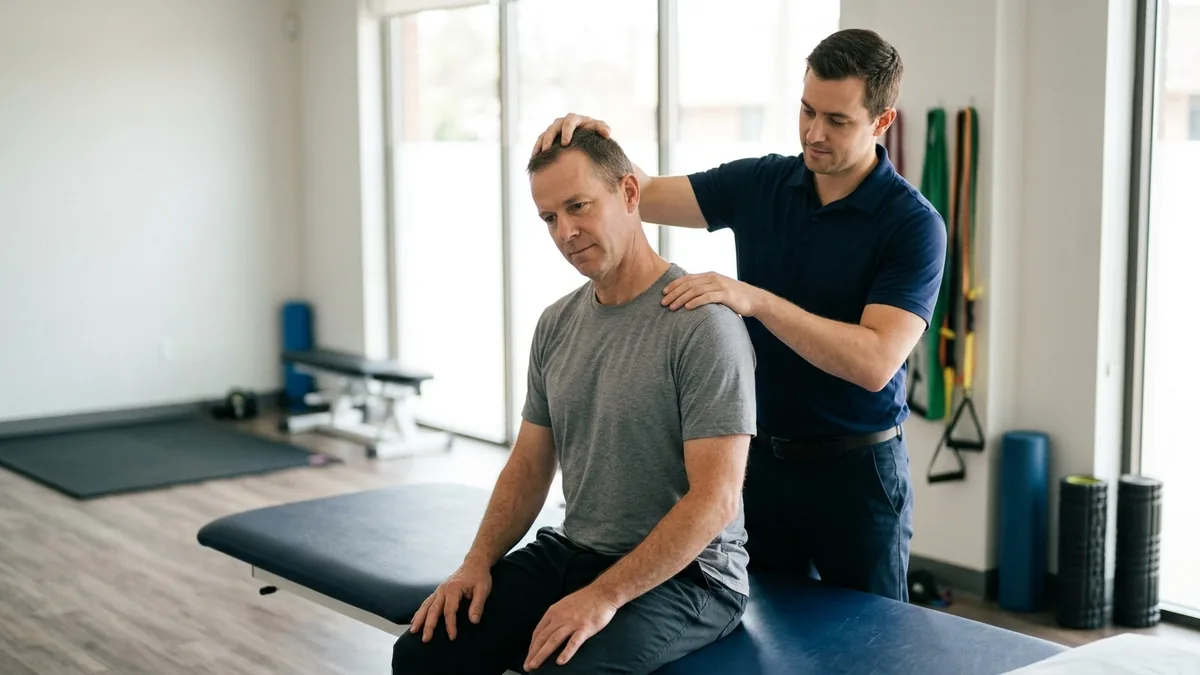
What a physiotherapist can do is look at how your neck moves, how you sit and work, and whether your posture or habits could be adding strain. If the neck is part of the picture, exercises and advice may help.
Our guides on neck pain from sitting at a desk and neck pain for office workers explain what we look at and what you can try.
What can you change at your desk?
These simple habits match the workstation advice on our own neck pain pages. They are general advice, not NHS guidance. They cost nothing and they are worth a try.
- Raise your screen so the top is at eye level.
- Keep your keyboard where your elbows sit at about 90 degrees, with your shoulders relaxed and your feet flat.
- Change position often. A short break every 30 minutes to stand up and relax your shoulders is a good habit.
- Gently turn your head left and right within a comfortable range.
- Drink water through the day and do not skip meals.
If you do not get better, see a GP or a physiotherapist rather than waiting. Our guide on mobility exercises for desk workers has a few easy moves.
When should you see a GP about a headache?
See your GP if:
- you get headaches several times a week or they are severe
- painkillers and relaxation do not help
- you have throbbing pain at the front or on one side of your head
- you feel sick, vomit, or find light or noise painful
These can be signs of a different type of headache, such as a migraine or cluster headache, according to the NHS.
Get urgent medical help if you have a severe headache and any of these: jaw pain when eating, blurred or double vision, a sore scalp, or numbness or weakness in your arms or legs. In Ireland, contact your GP or out of hours service straight away, and call 112 or 999 in an emergency. The NHS page uses the UK number 111 for these signs.
How can a physiotherapist help?
A physiotherapist does not replace your GP. If your GP has ruled out other causes, or you are not sure where your neck pain ends and your headache begins, a physiotherapist can help in these ways.
- Assess how your neck moves in every direction, which joints feel stiff, and how strong the deep neck muscles are.
- Look at your sitting posture and how you work, and give workstation advice.
- Explain what is likely to help and what to avoid.
- Give you a personalised exercise programme through our Physitrack app, with video guidance.
- Where deep trigger points in the neck and shoulder muscles are adding to the pain, offer dry needling as part of the plan.
At Physio Performance in Drogheda we will tell you honestly what to expect and when you should see your GP first.

Frequently asked questions
What is a tension headache?
A tension headache is the most common headache. The NHS says it causes pain on both sides of the head, face or neck, often like pressure or a tight band, and that it is not a sign of an underlying condition. You can usually carry on with your day, although you may feel uncomfortable.
How long does a tension headache last?
The NHS says they last at least 30 minutes and can last much longer, sometimes for several days. If they come several times a week, or they are severe, see your GP. Do not rely on painkillers every day, because that can cause headaches of its own.
Can neck pain cause headaches?
The NHS links neck pain and these headaches and suggests a low, firm pillow and heat or cold packs when you have both. A physiotherapist can check how your neck moves and how you sit, but your GP should look at any headache that is severe or does not settle.
What is the quickest way to relieve a tension headache?
The NHS suggests painkillers such as paracetamol, aspirin or ibuprofen, plus relaxation such as exercise, yoga or massage, and better sleep habits. Cut down on caffeine. Rest in a quiet room if you can. Ask a pharmacist which painkiller suits you, and avoid taking them too often.
When should I worry about a headache?
See your GP if headaches are frequent, severe or do not respond to painkillers. Get urgent help if a severe headache comes with jaw pain when eating, blurred or double vision, a sore scalp, or numbness or weakness. In Ireland call your GP, or 112 or 999 in an emergency.
Conclusion
A tension headache is common and usually not serious. It feels like a tight band, it responds to rest, relaxation and simple painkillers, and it is often linked to stress, sleep and a tight neck. See your GP if the pattern changes or if you have any warning sign. If your neck and posture may be part of the problem, Physio Performance in Drogheda can assess you and give you a plan. Book online or call 041 987 7059.
Physio Performance, Drogheda. Call 041 987 7059.