
Physio Performance, Health & Fitness
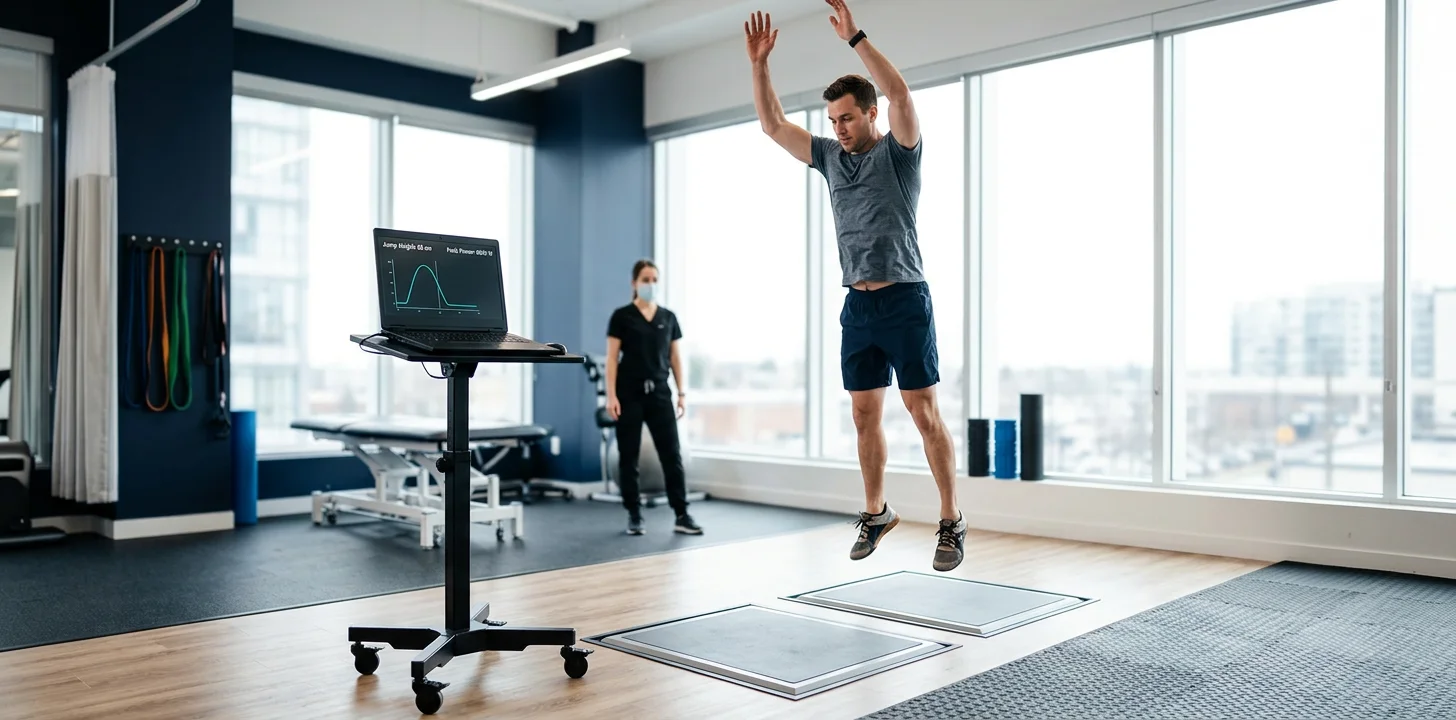
What Is VALD Forcedecks? The Force Plate Technology Used by Elite Sports Teams
If you have ever wondered how elite sports teams decide exactly when an injured player is ready to return to competition, or how they identify which players are at higher risk of injury before it even happens, the answer increasingly involves a pair of force plates and a piece of technology called VALD Forcedecks.
VALD Forcedecks has become one of the most widely used assessment tools in professional sport, from soccer and rugby academies to Olympic training centres. It removes guesswork from return to sport decisions and replaces it with objective, measurable data. And it is now available right here in Drogheda.
This guide explains exactly what VALD Forcedecks is, how it works, and why it has become such an important tool in modern sports injury prevention and rehabilitation.
What Is VALD Forcedecks?
VALD Forcedecks is a dual force plate system used to measure a wide range of athletic and rehabilitation metrics through jumping, landing and balance based tests. The system consists of two separate force plates positioned side by side, allowing each leg to be measured independently and simultaneously during the same movement.
Unlike a single-plate system, the dual-plate design of VALD Forcedecks is what makes it so valuable for injury assessment. Because each leg lands on its own plate, the system captures precise data on how much force, power and control each individual limb is producing, rather than just an average across both legs combined. This allows a physiotherapist to identify exactly where an asymmetry or weakness exists, something that simply is not possible with traditional fitness testing equipment.
VALD Forcedecks is used across professional sport globally, including by clubs in the English Premier League, NRL and AFL, as well as Olympic and international sporting federations. The same technology used to monitor elite professional athletes is now part of the assessment toolkit available to patients at Physio Performance in Drogheda.

How Does VALD Forcedecks Work?
A VALD Forcedecks assessment uses a series of standardised jump and landing tests, the most common being the countermovement jump, where the athlete performs a vertical jump from standing, and the drop jump, where the athlete steps off a small platform and immediately jumps again on landing.
During each test, the force plates measure ground reaction force thousands of times per second on each leg independently. This raw data is processed to calculate a wide range of metrics including jump height, peak power output, rate of force development, landing impulse and, critically, the asymmetry between the left and right leg across each of these measures.
Research using force plate technology has consistently shown that biomechanical markers from jump and landing testing, including asymmetric force application and reduced landing control, are associated with elevated injury risk, particularly for non-contact ACL injuries which most commonly occur during jump-landing and rapid deceleration movements (Source: PMC Systematic Review, Biomechanical Assessment Tools for Injury Risk Prediction).
For athletes recovering from injury, particularly ACL reconstruction, VALD Forcedecks plays a central role in determining genuine readiness to return to sport. Studies using force plate testing in post-ACL reconstruction athletes have found that limb symmetry deficits can persist even after an athlete has passed conventional strength and hop testing, reinforcing the value of comprehensive force plate assessment as part of a full return to sport battery rather than relying on a single test alone (Source: International Journal of Sports Physical Therapy).
What Does VALD Forcedecks Measure?
A VALD Forcedecks assessment provides a detailed profile across several key performance and injury risk domains.
Jump Height and Power. Total vertical jump height and the power generated to produce it, giving a baseline measure of explosive lower limb performance that can be tracked over time.
Landing Force and Control. How much force is absorbed through each leg on landing, and how quickly the athlete is able to stabilise. Poor landing control is strongly linked to increased injury risk, particularly for the knee.
Limb Symmetry Index. A precise percentage comparison of left versus right leg performance across multiple metrics. This is one of the most clinically useful outputs of VALD Forcedecks, since it identifies exactly which side is underperforming and by how much.
Rate of Force Development. How quickly an athlete is able to generate force, which is a critical quality for sprinting, change of direction and explosive movements common in GAA, soccer and rugby.
Reactive Strength Index. A measure of how efficiently an athlete converts landing force back into the next jump, which reflects tendon stiffness and overall lower limb reactive capacity.

Who Should Get a VALD Forcedecks Assessment?
VALD Forcedecks is valuable across a wide range of patients and athletes, not only elite professionals.
Athletes returning from ACL reconstruction or other significant lower limb injuries should undergo VALD Forcedecks testing before being cleared to return to full training and competition. This provides objective evidence of genuine readiness rather than relying on time elapsed since surgery or subjective feeling of confidence alone.
GAA, soccer and rugby players preparing for a new season benefit from baseline VALD Forcedecks testing to identify any existing asymmetries or weaknesses before they contribute to an injury during the season.
Athletes with a history of recurrent lower limb injuries, including ankle sprains, knee pain or hamstring problems, gain valuable insight from VALD Forcedecks testing, since it can reveal underlying movement deficits that may be contributing to the ongoing pattern of injury.
Recreational athletes and gym-goers preparing for events such as a marathon, or simply wanting to understand their current lower limb power and control, also benefit from a baseline assessment.
For athletes who have suffered a hamstring injury specifically, VALD Forcedecks is often used alongside our HRIG Hamstring Assessment to provide a complete picture of both eccentric hamstring strength and overall lower limb jump and landing mechanics. If you are recovering from an ACL injury, our dedicated guide on ACL recovery physiotherapy in Drogheda covers the full rehabilitation pathway.
VALD Forcedecks at Physio Performance in Drogheda
Physio Performance uses VALD Forcedecks as part of a comprehensive sports performance and injury prevention service for athletes across Drogheda, Louth and the surrounding region. Our clinical team integrates VALD Forcedecks data directly into rehabilitation planning, return to sport decision making and pre-season screening programmes.
A typical VALD Forcedecks assessment session takes approximately 30 to 45 minutes and includes a full battery of jump and landing tests, a detailed report comparing your results against normative data for your sport and level, and a clear discussion of any identified asymmetries or deficits along with a practical plan to address them.
If you are returning from a significant lower limb injury, preparing for a new competitive season, or simply want an objective baseline of your current power and movement quality, book a VALD Forcedecks assessment with our team today.
Frequently Asked Questions About VALD Forcedecks
VALD Forcedecks is a dual force plate system used to measure jump height, power, landing control and limb asymmetry. It is widely used in professional sport to guide injury prevention screening and to objectively determine when an athlete is ready to return to sport after injury, particularly following ACL reconstruction.
No. While VALD Forcedecks is used extensively in professional sport, it is equally valuable for recreational athletes, GAA and club level players, and anyone recovering from a significant lower limb injury who wants an objective assessment of their readiness to return to activity.
A typical VALD Forcedecks assessment at Physio Performance takes between 30 and 45 minutes, including a full battery of jump and landing tests and a detailed discussion of the results.
VALD Forcedecks cannot guarantee prediction of any specific injury, but research has consistently linked biomechanical markers such as landing asymmetry and reduced force control to elevated ACL injury risk. VALD Forcedecks provides the objective data needed to identify these risk factors so they can be addressed proactively.
No. Anyone interested in understanding their lower limb power, control and symmetry can book a VALD Forcedecks assessment, whether you are a competitive athlete, a recreational gym-goer, or recovering from injury.
Physio Performance offers VALD Forcedecks assessment as part of its sports performance and rehabilitation service in Drogheda, serving athletes and patients from across Louth, Meath and the wider region.