
Physio Performance, Health & Fitness
The Best Exercises for Frozen Shoulder: A Step by Step Physiotherapy Guide
The most common mistake with exercises for frozen shoulder is doing the right exercises at the wrong time. A stretching programme that is appropriate and effective in the frozen stage will actively worsen symptoms if performed during the painful freezing stage.
That single point explains why so many people report that their exercises made things worse, and why so many others give up believing exercise does not help. It does help. The staging is what matters.
This guide sets out which exercises for frozen shoulder are appropriate at each stage, how to perform them correctly, and how to tell which stage you are currently in.
Identify Your Stage First
Frozen shoulder progresses through three distinct stages, and the correct exercise approach differs completely between them.
Freezing stage. Pain is the dominant symptom and it is often severe, particularly at night. Movement is becoming restricted but pain is what limits you rather than stiffness. This stage typically lasts between two and nine months. Aggressive stretching here increases inflammation and prolongs the condition.
Frozen stage. Pain has reduced considerably but stiffness now dominates. The shoulder is genuinely restricted rather than painful, and you may notice the pain settling while the movement gets no better. This stage lasts roughly four to twelve months and is where stretching becomes both appropriate and productive.
Thawing stage. Movement is gradually returning. Pain is minimal. This is where strengthening becomes the priority to restore full function.
The simplest self-check is asking what stops you moving the arm. If it is pain, you are likely freezing. If it is a hard blocked sensation with less pain, you are likely frozen.
Exercises for the Frozen Stage
Once the acute pain has settled and stiffness is the dominant restriction, stretching becomes both appropriate and necessary. This is the stage where consistent work produces genuine range gains.
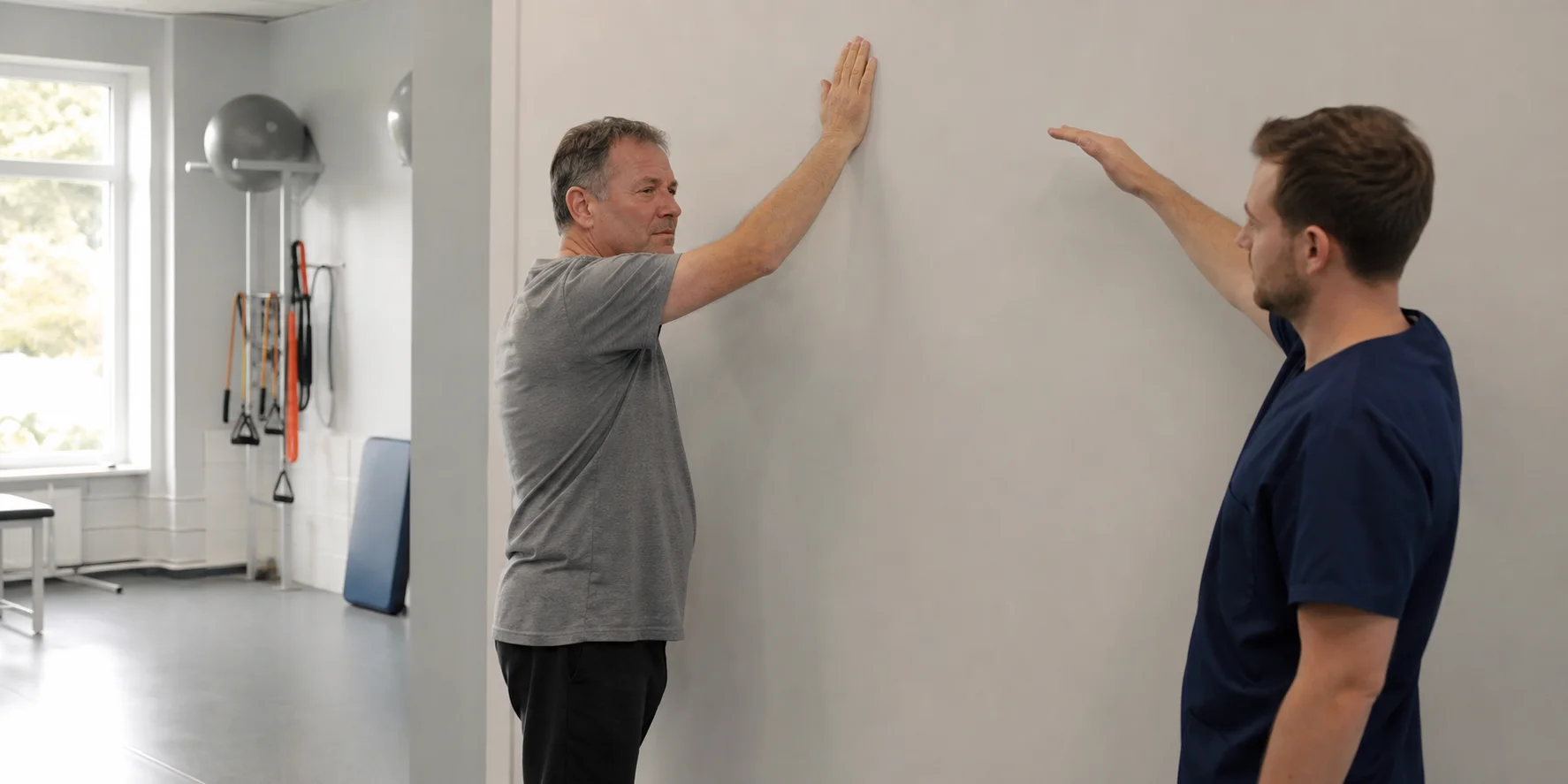
Wall walking. Stand facing a wall at arm’s length. Place your fingertips on the wall and walk them upward, letting your arm rise as far as tolerable. Hold at your end point for fifteen seconds, then walk back down. Mark the height you reach with a piece of tape and aim to progress it weekly. This gives you a visible measure of progress, which matters psychologically in a condition that improves slowly.
Towel stretch for internal rotation. Hold a towel behind your back with the affected hand at the bottom and the good hand over your shoulder at the top. Gently pull upward with the good hand, drawing the affected arm into internal rotation. Hold twenty to thirty seconds, five repetitions. This targets reaching behind your back, which is usually the most functionally limiting restriction.
Cross body stretch. Use your good arm to draw the affected arm across your chest. Hold thirty seconds, five repetitions. Targets the posterior capsule.
External rotation with a stick. Standing with your elbow at your side bent to ninety degrees, hold a stick and use the good arm to push the affected forearm outward. Hold twenty seconds, five repetitions. External rotation is characteristically the most restricted direction in frozen shoulder and needs specific attention.
Doorway stretch. Standing in a doorway with your forearm against the frame, elbow at shoulder height, gently rotate your body away. Hold twenty seconds.
The principle in this stage is sustained gentle tension rather than forceful pushing. You should feel a stretch, not sharp pain. Frequency matters more than intensity, and two sessions daily consistently outperforms one longer session.
Our companion guide on NHS exercises for frozen shoulder covers the standard exercise sheet approach in more detail.

Exercises for the Thawing Stage
As range returns, the priority shifts from restoring movement to rebuilding the strength lost during months of reduced use.
Resisted external rotation. With a resistance band anchored at elbow height and a rolled towel between elbow and ribs, rotate the forearm outward slowly. Three sets of twelve.
Resisted internal rotation. The same setup rotating inward.
Scapular retraction rows. Drawing the shoulder blades back and down against band resistance. Three sets of twelve.
Progressive elevation with light weight. Raising the arm forward and to the side holding a light weight, building gradually.
Functional rehearsal. Practising the specific movements you need for work or daily life, whether that is reaching overhead, lifting, or reaching behind your back.
This stage is frequently skipped because people feel better once the range returns. Skipping it leaves the shoulder weaker than before the condition began and vulnerable to secondary problems.

How Often and How Hard
Frequency beats intensity. Two short sessions daily produce considerably better results than one long session every other day. The capsule responds to frequent gentle input rather than occasional forceful stretching.
Duration of hold. Twenty to thirty seconds per stretch in the frozen stage. Shorter holds do not produce lasting change in connective tissue.
Pain guidance. A stretching sensation at end of range is appropriate. Sharp pain, or pain that persists for more than an hour afterwards, means you pushed too far.
Warmth before stretching. A warm shower or heat pack applied for ten minutes before your exercises makes the tissue more responsive and the session more comfortable.
Expect slow progress. Frozen shoulder improves over months rather than weeks. Measuring your wall walk height weekly rather than daily prevents the discouragement that comes from expecting rapid change.
When Exercises Alone Are Not Enough
Home exercises are the foundation but they cannot replicate everything a physiotherapist provides.
Hands-on joint mobilisation applies specific directional forces to the capsule that you cannot generate yourself. This consistently accelerates range gains compared to home exercise alone.
Accurate staging matters and is difficult to self-assess. Performing frozen-stage stretches during the freezing stage is the single most common self-management error and it prolongs the condition significantly.
Progression decisions benefit from objective measurement. At our clinic in Drogheda we track range and strength using VALD Forcedecks assessment, which means progression is based on measured change rather than impression.
For patients where pain is preventing any meaningful exercise, treatments including our shockwave therapy and dry needling services can reduce pain enough to allow the loading programme to begin.
If your exercises have not produced measurable improvement over six weeks, book an assessment at our clinic in Drogheda so the staging and the programme can be checked properly. You can also download our free neck and shoulder pain report.
For the surgical pathway if conservative treatment does not resolve things, see our guides on frozen shoulder operations and frozen shoulder surgery.
Evidence on exercise and manual therapy for adhesive capsulitis is published in the British Journal of Sports Medicine, and patient guidance is available through the Chartered Society of Physiotherapy.
Frequently Asked Questions
It depends entirely on your stage. In the painful freezing stage, pendulum swings and supported movement are appropriate. In the stiff frozen stage, wall walking, towel stretches and external rotation stretches are most effective. In the thawing stage, resisted strengthening becomes the priority.
Twice daily, every day. Consistency and frequency produce better results than occasional longer sessions, because connective tissue responds to regular gentle input.
You should feel a stretch at end of range. Sharp pain, or pain persisting more than an hour after the session, indicates you have pushed too far and may worsen the condition.
Yes, if performed at the wrong stage. Aggressive stretching during the painful freezing stage increases capsular irritation and prolongs the condition. Matching the exercise to the stage is essential.
Measurable range improvement typically appears within four to eight weeks of consistent daily work in the frozen stage. Full recovery commonly takes six to twelve months with a condition that improves slowly by nature.
Related reading
Struggling with this? See our shoulder pain treatment in Drogheda.