Shockwave Therapy Drogheda at Physio Performance is one of the most effective and most misunderstood treatment options available for persistent pain and injury conditions that have not responded to standard physiotherapy, rest, or medication. If you have been dealing with heel pain, Achilles problems, a stubborn shoulder injury, or chronic tendon pain for months and nothing has given you lasting relief, shockwave therapy may be exactly what your body needs to finally break the cycle.
This guide covers exactly what shockwave therapy is, how it works, which conditions it treats most effectively, and what you can expect from treatment at Physio Performance in Drogheda.
1. What Is Shockwave Therapy and How Does It Work
Shockwave therapy is a non-invasive treatment that uses high-energy acoustic pressure waves to stimulate healing in damaged or degenerated tissue. The technology was originally developed for breaking down kidney stones and has been progressively refined over the past three decades into one of the most effective tools available for treating chronic musculoskeletal conditions that have not responded to conventional treatment.
The mechanism of action is specific and well-documented. When acoustic pressure waves are delivered to damaged tissue, they trigger a controlled biological response that stimulates blood vessel formation, activates the body’s natural tissue repair processes, reduces calcification within tendons, and modulates the pain signals that chronic conditions produce. In plain terms: shockwave therapy wakes up tissue that has stopped healing on its own and gives it the stimulus it needs to recover properly.
This is particularly relevant for tendinopathy conditions — the category of chronic tendon degeneration that includes plantar fasciitis, Achilles tendinopathy, patellar tendinopathy, and rotator cuff tendinopathy. These conditions are notoriously difficult to treat with conventional methods because the tendons involved have poor blood supply and limited natural healing capacity. Shockwave therapy addresses this directly by stimulating the biological processes that drive genuine tissue recovery.
2. Who Is Shockwave Therapy Most Effective For
Shockwave Therapy Drogheda at Physio Performance is most effective for patients who meet one of these profiles:
Chronic tendinopathy that has not responded to standard treatment. If you have had heel pain, Achilles pain, knee pain, or shoulder pain for three months or more and physiotherapy, rest, stretching, and anti-inflammatory medication have not produced lasting relief, you are in the category of patient for whom shockwave therapy typically produces the most dramatic results. Research consistently shows that shockwave therapy produces significant improvement in chronic tendinopathy cases where other treatments have failed.
Patients who want to avoid steroid injections or surgery. Shockwave therapy is frequently used as an alternative to corticosteroid injections — which provide short-term pain relief but are associated with tissue weakening and reduced long-term outcomes — and as a conservative alternative to surgery for conditions like plantar fasciitis and calcific shoulder tendinopathy. The evidence base for shockwave therapy as a surgery-delaying or surgery-avoiding intervention is strong.
Athletes with performance-limiting tendon conditions. GAA players, runners, cyclists, and other athletes dealing with tendon conditions that are preventing training and competition benefit significantly from shockwave therapy because it accelerates the tissue remodelling process that allows return to full training faster than rest and physiotherapy alone.
Patients with calcific shoulder tendinopathy. This specific condition — where calcium deposits form within the rotator cuff tendon — responds particularly well to shockwave therapy. The acoustic pressure waves break down the calcium deposits directly, providing relief that other interventions cannot deliver.
The hamstring muscle group consists of three muscles — the biceps femoris, the semimembranosus, and the semitendinosus — running from the ischial tuberosity at the base of the pelvis down to the back of the knee. Injuries can occur anywhere along this length but are most common at the musculotendinous junction — the point where the muscle transitions into tendon — and at the proximal tendon attachment near the sit bone.
Grades of hamstring injury:
Grade 1: A mild strain involving a small number of muscle fibres. The hamstring feels tight and uncomfortable but there is no significant loss of strength or range. Recovery with proper rehabilitation is typically 1 to 3 weeks.
Grade 2: A moderate partial tear involving a larger proportion of fibres. There is noticeable pain, localised bruising in many cases, and a clear reduction in strength. Recovery typically takes 4 to 8 weeks — but only with a properly structured rehabilitation programme. This is the grade most commonly mismanaged by returning too soon.
Grade 3: A severe tear involving most or all of the muscle fibres. Significant pain, bruising, and inability to use the leg normally. Rare but serious — requires comprehensive assessment and in some cases surgical review. Recovery can take 3 to 6 months.
Proximal hamstring tendinopathy: Pain at the sit bone — the bony prominence at the base of the pelvis. Not an acute tear but a gradual overload of the proximal hamstring tendon. Notoriously slow to respond to standard hamstring treatment and requires a very specific progressive loading approach.
Understanding which of these you are dealing with is not possible without a proper assessment — and getting it wrong leads directly to the re-injury cycle described above.
3. Shockwave Therapy Drogheda: The Proven Conditions We Treat
3.1 Plantar Fasciitis and Heel Pain
Plantar fasciitis — the most common cause of heel pain — is one of the conditions that shockwave therapy treats most effectively. The plantar fascia is a thick band of tissue running along the sole of the foot that, when overloaded or degenerated, produces sharp, debilitating pain at the heel that is typically worst with the first steps in the morning.
Most patients with plantar fasciitis try stretching, orthotics, rest, and physiotherapy. Many improve. A significant proportion — particularly those with pain lasting more than 3 months — do not achieve lasting relief through these methods alone. For this group, shockwave therapy consistently produces outcomes that other treatments cannot match.
Research published in peer-reviewed journals consistently shows that 60 to 80 percent of patients with chronic plantar fasciitis report significant improvement or complete resolution of symptoms following a course of shockwave therapy. At Physio Performance, shockwave therapy for plantar fasciitis is combined with a progressive loading programme and footwear assessment to address both the symptoms and the loading patterns that caused the condition.
For more on heel pain management and custom orthotics that support recovery, see our Custom Orthotics page.
3.2 Achilles Tendinopathy
Achilles tendinopathy — persistent pain and stiffness in the Achilles tendon, typically located at the mid-portion or at the tendon’s attachment point at the heel — is one of the most common and most frustrating conditions affecting runners and field sport athletes in Ireland.
The Achilles tendon has limited blood supply, which means its natural healing capacity is poor. Chronic Achilles tendinopathy often involves structural changes to the tendon tissue that do not respond to rest or gentle stretching. Progressive loading exercises — particularly heavy slow resistance work and eccentric training — are the gold standard first-line treatment. For cases that do not respond adequately to this approach, shockwave therapy is the evidence-based next step.
Shockwave therapy for Achilles tendinopathy stimulates the cellular processes that drive tendon remodelling — effectively restarting the healing process in tissue that has stopped progressing on its own. Combined with the progressive loading programme that continues alongside treatment, shockwave therapy consistently produces significant improvement in patients who have plateaued with exercise therapy alone.
See our full guide on Achilles Tendinopathy Treatment for a detailed breakdown of the complete treatment approach.
3.3 Patellar Tendinopathy
Patellar tendinopathy — pain at the front of the knee at the patellar tendon, commonly called jumper’s knee — is prevalent in GAA players, basketball players, volleyball players, and any athlete who performs repeated jumping and sprinting. It is one of the most persistent performance-limiting conditions in field sport athletes because the patellar tendon is under enormous load in every training session and every game.
Like all tendinopathy conditions, patellar tendinopathy requires a carefully structured progressive loading programme as the primary treatment. For athletes who are not responding adequately to loading, or who need to accelerate their recovery to meet competition timelines, shockwave therapy provides a significant additional stimulus that drives the tendon remodelling process forward.
At Physio Performance, shockwave therapy for patellar tendinopathy is delivered as part of a comprehensive treatment plan that includes VALD ForceDecks testing to objectively measure load capacity before and after treatment. This ensures that return to full training is cleared based on data rather than on how the tendon feels on a given day.
For more on knee pain assessment and treatment, see our Knee Pain guide.
3.4 Rotator Cuff Tendinopathy and Calcific Tendinitis
Shoulder pain is one of the most common presentations at Physio Performance, and shockwave therapy is one of our most effective tools for two specific shoulder conditions: rotator cuff tendinopathy and calcific tendinitis.
Rotator cuff tendinopathy involves degeneration of one or more of the four rotator cuff tendons — typically the supraspinatus — producing pain with overhead movements, sleeping on the shoulder, and reaching behind the back. Standard physiotherapy including rotator cuff strengthening and scapular stabilisation exercises is the first-line treatment. For cases not responding to this approach, shockwave therapy accelerates the tendon healing process significantly.
Calcific tendinitis involves the formation of calcium deposits within the rotator cuff tendon — causing significant pain and, in acute cases, one of the most intense pain episodes a patient can experience. Shockwave therapy is uniquely effective for this condition because the acoustic pressure waves break down the calcium deposits directly, providing relief and facilitating reabsorption that other treatments cannot achieve. The evidence base for shockwave therapy in calcific shoulder tendinitis is among the strongest in the entire field of musculoskeletal shockwave research.
3.5 Greater Trochanteric Pain Syndrome
Greater trochanteric pain syndrome — pain on the outer hip, often described as a deep ache that worsens with lying on the affected side, climbing stairs, or sitting with legs crossed — involves the gluteal tendons and bursa at the outer hip. It is particularly prevalent in women over 40 but affects athletes across all demographics.
This condition can be extremely persistent and significantly limiting to daily activity and exercise. Shockwave therapy combined with gluteal strengthening and load management produces excellent outcomes for this condition — significantly better than steroid injection alone, which is still commonly offered as a first-line treatment despite the evidence favouring shockwave therapy.
3.6 Chronic Lower Back Pain
For specific presentations of chronic lower back pain involving myofascial trigger points — tight, painful knots within the muscles that generate referred pain patterns — shockwave therapy can provide significant relief where other interventions have been partially effective or ineffective.
Shockwave therapy for lower back pain targets the trigger points within the paraspinal muscles and gluteal muscles that are frequently involved in chronic pain patterns. The acoustic pressure waves release the trigger points and stimulate local circulation in tissue that has become chronically restricted. This is used as part of a comprehensive lower back treatment programme rather than as a standalone intervention.
For our complete approach to lower back pain treatment, see our Lower Back Pain page and download our Free Lower Back Pain Guide.
4. What to Expect From Shockwave Therapy at Physio Performance Drogheda
4.1 Initial Assessment
Every patient referred for shockwave therapy at Physio Performance begins with a comprehensive one-to-one assessment. We find the root cause of the pain, confirm that shockwave therapy is the appropriate treatment for this specific presentation, and build a complete treatment plan that combines shockwave therapy with any additional physiotherapy and exercise components needed to address the underlying issue rather than just the symptom.
Shockwave therapy is not appropriate for every patient or every presentation. Your therapist will identify whether it is right for you based on your clinical presentation, your history, and your treatment goals.
4.2 The Treatment Session
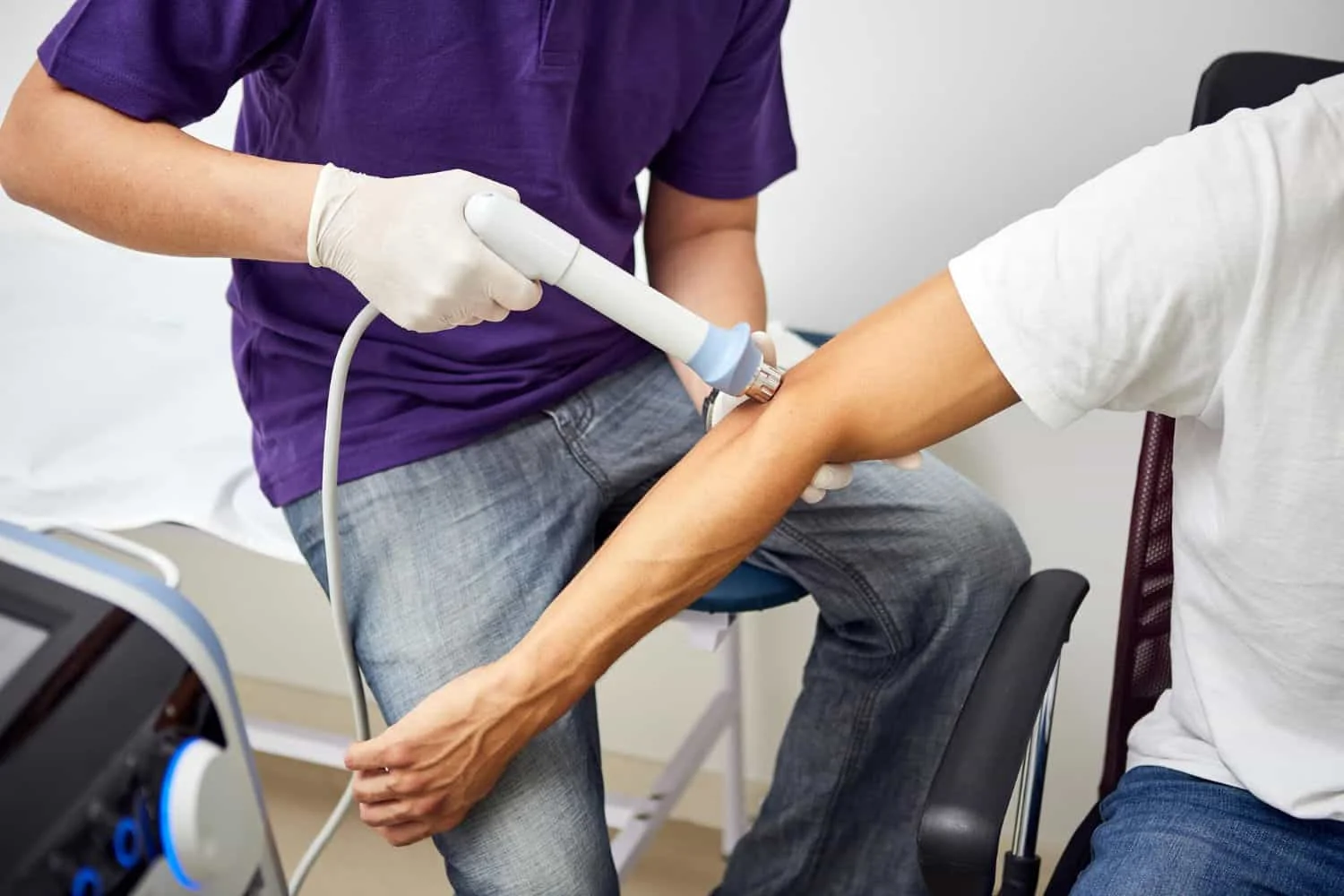
A shockwave therapy session at Physio Performance typically takes 20 to 30 minutes. The shockwave applicator is applied directly to the skin over the treatment area, usually with ultrasound gel to ensure optimal transmission of the acoustic waves. The patient feels a series of pressure pulses — described by most patients as a deep, rapid tapping sensation. The intensity is adjusted to a level that is effective without being intolerable.
During treatment it is normal to feel some discomfort — particularly over the most sensitive area of the tendon. This discomfort is expected and is a sign that the treatment is reaching the target tissue. Most patients rate the discomfort as manageable and significantly preferable to the ongoing pain and limitation of the condition being treated.
4.3 Number of Sessions and Expected Outcomes
Most conditions respond to a course of 3 to 6 shockwave therapy sessions delivered at weekly intervals. The exact number depends on the specific condition, the chronicity of the presentation, and the individual patient’s response to treatment.
Most patients notice some improvement within the first 2 to 3 sessions. Full benefit typically develops over 6 to 12 weeks following the completion of the course as the biological tissue remodelling process continues after treatment ends. It is important to understand that shockwave therapy initiates a healing process — the results build progressively over the weeks following treatment rather than appearing immediately after each session.
4.4 Post Treatment Guidelines
In the 24 to 48 hours following each shockwave therapy session, patients typically experience some temporary increase in soreness in the treatment area. This is a normal tissue response to the treatment and generally settles within a day or two. Anti-inflammatory medication should be avoided immediately after treatment as it can interfere with the inflammatory process that shockwave therapy is deliberately stimulating.
Activity modification guidance is provided at each session based on the patient’s specific condition and treatment stage.
5. Is Shockwave Therapy Painful
This is the question most patients ask before their first session and it deserves an honest answer. Shockwave therapy is not painless — particularly in the initial sessions when the treatment area is most sensitive. Most patients describe the sensation as a deep, repetitive pressure or tapping that is uncomfortable over the most tender areas.
However the discomfort is entirely manageable and tolerable for the vast majority of patients. The intensity is adjusted based on patient feedback throughout every session. As the course of treatment progresses and the tissue begins to respond, sensitivity at the treatment area typically reduces and sessions become progressively more comfortable.
The important context is that shockwave therapy is specifically recommended for conditions that have been causing significant pain and limitation for months or years. The temporary discomfort of treatment is consistently regarded by patients as entirely acceptable compared to the ongoing daily pain and restriction they have been managing without improvement.
According to research published in the Journal of Orthopaedic Surgery and Research, shockwave therapy demonstrates a strong safety profile with minimal adverse effects across thousands of documented cases, making it one of the most evidence-supported non-surgical interventions for chronic musculoskeletal conditions.
6. Shockwave Therapy at Physio Performance Drogheda
At Physio Performance in Drogheda, shockwave therapy is delivered by experienced chartered physiotherapists as part of a comprehensive treatment approach — never in isolation. Every patient receives a full clinical assessment, a clear diagnosis, and a treatment plan that combines shockwave therapy with the exercise rehabilitation and physiotherapy components that address the root cause of the condition.
Our team includes therapists with specific expertise in tendinopathy management and sports injury rehabilitation. We work with GAA players, runners, triathletes, and general population patients across Drogheda, Co. Louth, and the surrounding areas who are looking for evidence-based treatment that produces real, lasting results.
You can book directly online — no GP referral needed. Or download our relevant free guides to learn more about your specific condition while you wait for your appointment: Free Hamstring Injury Guide, Free Knee and Hip Pain Guide, or Free Neck and Shoulder Pain Guide.
9. Frequently Asked Questions
Most conditions respond to a course of 3 to 6 sessions delivered at weekly intervals. Simpler presentations — such as early-stage plantar fasciitis — may resolve within 3 sessions. More complex or chronic conditions typically require the full 6-session course. Your therapist will give you a specific recommendation based on your assessment findings and will review progress throughout the course.
Most patients notice some improvement within 2 to 4 weeks of starting treatment. Full benefit typically develops over 6 to 12 weeks following the completion of the treatment course as the biological healing process continues after treatment ends. The results of shockwave therapy build progressively — it is not a treatment where you feel dramatically better immediately after each session.
In most cases yes — with modifications to reduce load on the treatment area during the course of treatment. Your therapist will provide specific activity modification guidance based on your condition and treatment stage. Maintaining appropriate activity during treatment is generally better for outcomes than complete rest.
Coverage varies by insurance provider and plan. Most major Irish health insurers including VHI, Laya, and Irish Life Health cover physiotherapy-based treatments with shockwave therapy components when delivered by a chartered physiotherapist. We recommend contacting your insurance provider directly to confirm your specific coverage before beginning treatment.
Both are advanced physiotherapy modalities available at Physio Performance but they work through different mechanisms. Shockwave therapy uses acoustic pressure waves to stimulate tissue healing and is primarily indicated for chronic tendinopathy and calcification conditions. TECAR therapy uses radiofrequency energy to generate deep therapeutic warmth within tissues and is primarily indicated for acute inflammation, muscle injury, and conditions requiring deep tissue circulation enhancement. Your therapist will determine which modality or combination is most appropriate for your specific presentation.