
Physio Performance, Health & Fitness
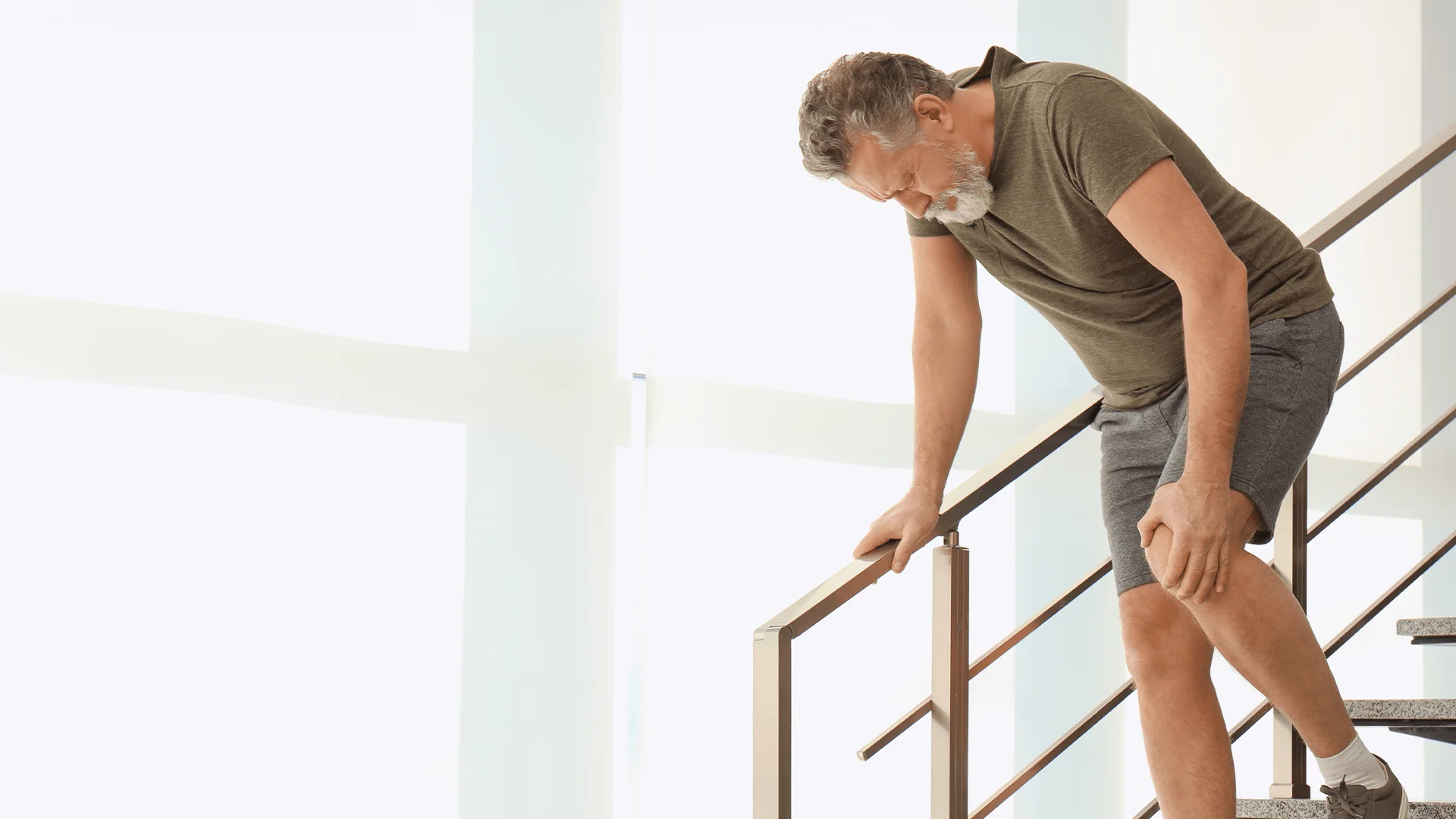
Knee pain walking down stairs is one of the most specific and most telling symptoms we see at Physio Performance in Drogheda. Not knee pain in general. Not knee pain during sport. Knee pain that happens specifically when you walk down stairs, lower yourself off a kerb, or descend a slope. Pain that is manageable going up but sharp, uncomfortable, or unreliable coming down.
If this is you, you are not alone. It is one of the most common complaints we hear in the clinic and one of the most consistently misunderstood. Most people assume the pain means something is seriously wrong with the knee joint itself. Most of the time it does not. Most of the time the pain is mechanical, it has a specific cause, and it responds very well to the right treatment once that cause is identified.
What causes knee pain walking down stairs specifically? Why downstairs and not upstairs? What should you do about it? This guide answers all of it.
1. Why Stairs Going Down Cause More Knee Pain Than Stairs Going Up
This is the question patients ask most often and it has a clear mechanical answer. When you descend stairs your body weight must be lowered in a controlled way. This means the quadriceps muscle at the front of your thigh must work eccentrically, contracting while lengthening, to control the rate at which your knee bends and your body lowers. This eccentric quadriceps load places significantly more compressive force through the patellofemoral joint, the joint between the kneecap and the femur, than the concentric quadriceps load of climbing stairs.
In addition descending stairs requires the knee to bend in a range where certain pain-generating structures including the patellar tendon, the infrapatellar fat pad, and the medial and lateral joint line are placed under significantly more load than during flat walking or stair climbing.
So knee pain walking down stairs specifically points to involvement of these structures. It is a diagnostic signal, not just a symptom. And it narrows the field of likely causes considerably when an experienced physiotherapist knows how to read it.
2. The Most Common Causes of Knee Pain Walking Down Stairs
Patellofemoral pain syndrome. The most common cause of knee pain walking down stairs in adults under 50. This involves pain at and around the kneecap driven by abnormal tracking of the patella in the femoral groove during knee flexion and extension under load. The compression force through the patellofemoral joint is significantly higher during stair descent than during walking on flat ground which is why this condition produces its most characteristic symptoms going downstairs.
Patellofemoral pain is almost always driven by a combination of quadriceps weakness, hip abductor weakness, and altered lower limb movement mechanics rather than by structural damage to the knee itself. It responds extremely well to targeted rehabilitation.
Patellar tendinopathy. Pain at the patellar tendon just below the kneecap. Common in athletes who perform repeated jumping and sprinting but also common in active adults who have recently increased their activity volume. The eccentric loading of stair descent places specific stress through the patellar tendon that flat walking does not replicate.
Medial or lateral meniscus irritation. The menisci are the shock-absorbing cartilage pads inside the knee joint. Irritation or partial tears of the meniscus produce pain at the joint line, the inner or outer side of the knee, that is characteristically provoked by weight-bearing in certain ranges of knee flexion. Stair descent moves the knee through exactly these ranges under load.
Knee osteoarthritis. In older adults, knee osteoarthritis is a common contributor to knee pain walking down stairs. The increased compressive load during stair descent loads the degenerative articular cartilage more significantly than flat walking. Importantly knee OA does not mean the knee cannot improve. Exercise and physiotherapy consistently produce significant improvements in pain and function even in the presence of significant arthritis.
IT band syndrome. Less commonly, irritation of the iliotibial band at its insertion on the outer side of the knee produces the specific lateral knee pain on stair descent that patients sometimes describe as the knee giving way or feeling unreliable going down.
Weak hip muscles. This is not a knee condition but it is one of the most consistent contributors to knee pain walking down stairs. When the hip abductors and external rotators are weak the femur drops inward during single leg loading, which happens every time you take a step on the stairs. This drop increases the compressive and shear forces through the medial knee and patellofemoral joint significantly. Treating the knee alone without addressing the hip weakness that is loading it incorrectly is one of the most common reasons knee pain returns after treatment.
3. Knee Pain Walking Down Stairs: The Proven Approach at Physio Performance
3.1 Assessment That Identifies Exactly What Is Going On
Every patient presenting with knee pain walking down stairs at Physio Performance begins with a thorough one-to-one assessment. The specific symptom pattern, the specific location of the pain, the structures that are provoked during clinical testing, and the contributing factors from the hip, foot, and lower limb mechanics all combine to produce a specific diagnosis and a specific treatment plan.
The assessment always includes a single leg squat assessment which replicates the mechanics of stair descent in a controlled clinical environment. Watching how the knee tracks, whether the hip drops, and where the pain is provoked during this movement tells us more about the cause of knee pain walking down stairs than any imaging study.
3.2 Quadriceps and Hip Rehabilitation
For the majority of patients with knee pain walking down stairs the most important treatment component is progressive strengthening of the quadriceps and the hip abductors and external rotators. These two muscle groups directly control the loading pattern through the knee during stair descent. Strengthening them changes the mechanics that are causing the pain.
The rehabilitation progression starts with exercises that load these muscles in pain-free ranges and progressively introduces the knee flexion angles and loading patterns of stair descent over 6 to 10 weeks. By the end of a properly progressed programme the patient is performing loaded single leg exercises that replicate the demands of stairs with no symptoms.
Every patient receives their programme through the Physitrack app with video guidance, clear instructions, and progressive targets.
3.3 Manual Therapy and Soft Tissue Treatment
Hands-on treatment targeting the quadriceps, the IT band, the hip flexors, and the knee joint itself plays a supporting role in treatment for knee pain walking down stairs. Joint mobilisation, soft tissue release, and patellar mobilisation where indicated help reduce pain and improve movement quality in the early stages of rehabilitation.
3.4 Shockwave Therapy for Patellar Tendinopathy
For patients whose knee pain walking down stairs is driven by patellar tendinopathy that has not responded adequately to progressive loading, Shockwave Therapy is a highly effective additional intervention that stimulates the tissue remodelling process in the degenerated tendon.
3.5 VALD ForceDecks Objective Assessment
For athletes recovering from significant knee conditions and requiring objective clearance for return to sport our VALD ForceDecks force plate assessment provides objective limb symmetry data that confirms the knee is genuinely ready for the demands of their sport rather than simply feeling better.
4. What You Can Do Right Now About Knee Pain Walking Down Stairs
While waiting for your physiotherapy appointment these practical steps will help manage knee pain walking down stairs without making the condition worse.
Modify but do not avoid stairs completely. Complete avoidance of stairs weakens the muscles needed for recovery. Modify by holding the handrail, stepping down one step at a time with the painful leg leading, and reducing speed.
Avoid sitting in deep knee flexion for extended periods. Prolonged sitting with the knee bent beyond 90 degrees increases the irritation of the patellofemoral joint. Try to sit with the knee at a comfortable angle and take regular movement breaks.
Start gentle quadriceps strengthening. Straight leg raises lying on your back are a zero compression quadriceps exercise that begins building the muscle capacity needed for stair descent without loading the painful structure. 3 sets of 15 repetitions twice daily is a practical starting point.
Ice after activity. Applying an ice pack wrapped in a damp cloth to the front of the knee for 15 minutes after activity that has provoked the pain helps manage the local tissue irritation.
For more on managing knee and hip conditions see our Free Knee and Hip Pain Guide and our Knee Pain Treatment Drogheda guide. You can book directly online with no GP referral needed.
5. How Long Does Knee Pain Walking Down Stairs Take to Resolve
Recovery timeline depends on the specific diagnosis and how consistently the rehabilitation programme is followed.
Patellofemoral pain syndrome with appropriate rehabilitation typically shows meaningful improvement within 4 to 8 weeks and significant or full recovery within 10 to 16 weeks.
Patellar tendinopathy typically requires 8 to 12 weeks of progressive loading for significant improvement.
Meniscal irritation responds variably but most presentations that are suitable for conservative management improve meaningfully within 6 to 10 weeks.
Knee osteoarthritis management is ongoing but most patients achieve meaningful reduction in knee pain walking down stairs within 8 to 12 weeks of a structured programme.
According to research published in the British Journal of Sports Medicine on patellofemoral pain management, exercise-based rehabilitation targeting quadriceps and hip strength produces significantly better long-term outcomes than passive treatment and pain management alone, supporting an active rehabilitation approach as the primary treatment for the most common cause of knee pain walking down stairs.
6. Frequently Asked Questions
It is common but it is not something you simply have to accept as an inevitable part of ageing. The most common causes of knee pain walking down stairs including patellofemoral pain, patellar tendinopathy, and early knee OA all respond well to physiotherapy-led rehabilitation regardless of age. Many patients in their 50s, 60s, and 70s achieve significant or full resolution of symptoms through a properly structured programme.
No. Stopping all exercise typically makes the condition worse by weakening the muscles that need to be strengthened for recovery. Low impact activities that do not provoke the knee pain including swimming, cycling, and walking on flat ground are usually well tolerated and should be maintained. Your physiotherapist will give you specific guidance on what is safe for your individual presentation.
In the majority of cases a thorough clinical assessment provides all the information needed to make an accurate diagnosis and begin effective treatment. Imaging is useful when specific pathology including meniscal tears or significant structural damage is suspected clinically, or when symptoms are not responding to conservative management as expected. Your therapist will advise whether imaging is indicated based on your clinical findings.
Yes and this is one of the most commonly missed contributing factors. Weakness of the hip abductors and external rotators causes the femur to drop inward during single leg loading producing increased compressive and shear forces through the knee that generate knee pain walking down stairs even when the knee itself has no structural problem. A thorough assessment always examines the hip when the knee is the presenting complaint.
The vast majority of conditions that cause knee pain walking down stairs respond very well to physiotherapy and conservative management without surgery. Even significant knee osteoarthritis and meniscal irritation respond well to exercise-based rehabilitation in most cases. Surgery is considered only after comprehensive conservative management has been thoroughly trialled and found insufficient, which is the minority outcome for this symptom presentation.