
Physio Performance, Health & Fitness
IT Band Rehab: The Complete Physiotherapy Programme for Full Recovery
Most people searching for IT band rehab have already tried the obvious things. They have foam rolled until it hurt. They have stretched the outside of the thigh in every position they could find on the internet. They have rested for two weeks, felt better, returned to running, and been in pain again within twenty minutes.
The reason those approaches fail is that they treat the location of the symptom rather than the source of the problem. Effective IT band rehab is a phased, progressive programme that spends most of its energy on the hip rather than the knee, and it is the reason properly rehabilitated runners return to full training and stay there rather than cycling through the same injury every season.
This guide sets out the complete evidence-based IT band rehab programme we use at our clinic in Drogheda, phase by phase.
Why IT Band Rehab Targets the Hip
The iliotibial band is a thick band of connective tissue running from the hip down the outside of the thigh to just below the knee. It is not a muscle. It has almost no contractile capacity and very limited elasticity. This single anatomical fact explains why so much conventional IT band advice fails.
The tension in the iliotibial band is largely determined by the two muscles that attach into it at the top: the tensor fasciae latae and part of the gluteus maximus. When the gluteus medius and hip external rotators are weak, the femur rotates inward excessively during the stance phase of running, which increases the compressive load between the IT band and the underlying tissue at the knee.
The pain is at the knee. The problem is at the hip. Every effective IT band rehab programme reflects this.
Research published in the British Journal of Sports Medicine has consistently identified hip abductor weakness as the primary modifiable risk factor in runners who develop iliotibial band syndrome, with strengthening programmes producing significant reductions in both pain and recurrence rates.
Phase 1: Load Reduction and Symptom Control (Weeks 1 to 3)
The first phase of IT band rehab is not about strengthening. It is about allowing the irritated tissue at the lateral knee to settle so that loading exercises can begin without provoking symptoms.
What to do in Phase 1
Stop running temporarily. This is the part most runners resist and the part that most determines the length of the overall recovery. Continuing to run through IT band pain repeatedly reloads an irritated structure and extends the inflammatory phase indefinitely.
Substitute with cross training that does not load the knee through the problematic thirty degree range. Swimming and pool running are ideal. Cycling can be appropriate if the saddle height is set high enough to avoid deep knee flexion, though some cyclists find it aggravating and should switch to swimming.
Begin gentle isometric gluteal activation. Side lying clamshells performed slowly with a two second hold at the top, and isometric hip abduction against a wall held for thirty seconds, both introduce load to the gluteus medius without any knee movement.
What not to do in Phase 1
Aggressive foam rolling directly over the painful area, deep static stretching of the IT band, and any running or repeated knee bending under load.

Phase 2: Progressive Hip and Glute Strengthening (Weeks 3 to 8)
Once the lateral knee pain has settled at rest and during daily activity, IT band rehab moves into the strengthening phase. This is where the actual correction happens and it is the phase most self-managed cases skip entirely.
The core exercises in Phase 2
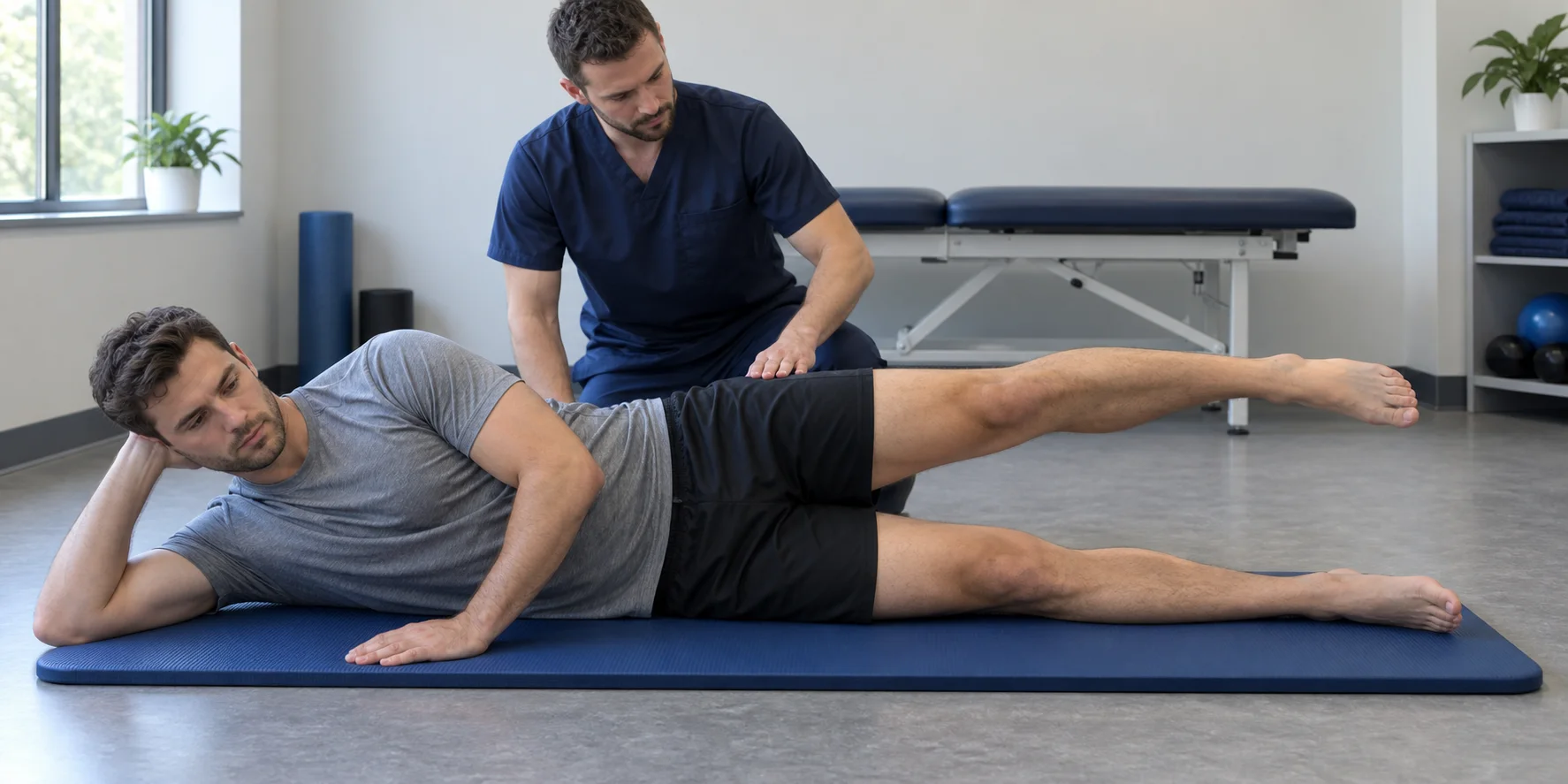
Side lying hip abduction. Performed with the top leg straight, toes pointed slightly downward toward the floor rather than upward, which biases the gluteus medius over the tensor fasciae latae. Three sets of twelve to fifteen repetitions, progressing to an ankle weight as capacity improves.
Banded clamshells. A resistance loop above the knees, controlled lift and slow lower, three sets of fifteen. The tempo matters more than the range, and rushing this exercise recruits the wrong muscles.
Lateral band walks. A resistance loop around the ankles or just above the knees, walking sideways in a partial squat position, maintaining constant tension on the band. Three sets of ten steps in each direction.
Single leg glute bridges. Lying on your back, one foot on the floor, lifting the hips while keeping the pelvis level. Three sets of ten per side. This targets the gluteus maximus which contributes significantly to controlling femoral rotation.
Single leg deadlift. Progressing to weight as control improves. This is the highest value exercise in the entire IT band rehab programme because it trains hip control in a single leg stance, which is functionally identical to the demand of running.
Throughout Phase 2 we assess progress objectively using our VALD Forcedecks system, which measures left to right force asymmetries and rate of force development. This means progression decisions are based on measured data rather than on how the patient feels on the day.
Phase 3: Running Mechanics and Return to Load (Weeks 8 to 12)
Strength alone does not guarantee a pain-free return to running. Phase 3 of IT band rehab addresses the mechanical factors that determine how much compressive load the IT band experiences with every stride.
Cadence adjustment. Research consistently demonstrates that increasing running cadence by five to ten percent above habitual rate reduces peak knee flexion during stance and consequently reduces IT band compression. For a runner with a natural cadence of 165 steps per minute, targeting 175 to 180 produces a measurable reduction in loading without any change to fitness or pace.
Stride width. Runners who cross their midline, effectively running on a narrow line, place greater adduction demand on the hip and increase IT band tension. Cueing a slightly wider stride reduces this.
Trunk position. A very upright running posture increases the demand on hip control. A slight forward lean from the ankles distributes load more effectively through the posterior chain.
Structured return to running programme. Beginning with short intervals of running interspersed with walking, progressively increasing running duration while monitoring for any return of symptoms. Most runners can return to their previous training volume within four to six weeks from the start of Phase 3 if strength work continues alongside.

How Long Does IT Band Rehab Take?
A properly executed IT band rehab programme typically takes eight to twelve weeks from the start of Phase 1 to full unrestricted running.
Mild cases identified early where the runner stops running immediately and begins hip strengthening promptly can complete the programme in six to eight weeks. Chronic cases where the runner has been managing symptoms for six months or more, and where significant hip weakness has developed, commonly require twelve to sixteen weeks.
The single biggest predictor of a shorter timeline is compliance with Phase 1. Runners who genuinely stop running for the initial two to three weeks recover substantially faster than those who continue running at reduced volume through the early phase.
For more on the specific exercises that actively slow recovery, our guide on IT band syndrome exercises to avoid covers the common errors in detail. To understand how the condition is diagnosed in the first place, read our guide to the iliotibial band syndrome test.
Preventing Recurrence After IT Band Rehab
Completing the programme is not the end. IT band syndrome has a meaningful recurrence rate in runners who stop their strengthening work once the pain resolves.
The maintenance requirement is modest. Two hip strengthening sessions per week, each taking approximately fifteen minutes, is sufficient to maintain the gluteal strength gains achieved during rehab. Runners who maintain this alongside sensible training load progression rarely experience recurrence.
Load management remains equally important. The ten percent rule, increasing weekly running volume by no more than ten percent, remains a reasonable guideline for most recreational runners. Sudden increases in volume, sudden introduction of hill running, or a rapid change in running surface are the three most common triggers for recurrence.
If you have completed a self-managed rehab attempt without full resolution, or if you want an objectively measured programme rather than a generic exercise sheet, book an assessment at our clinic in Drogheda and we will build the programme around your specific deficits. You can also download our free knee and hip pain report for additional guidance.
Frequently Asked Questions About IT Band Rehab
A complete IT band rehab programme typically takes eight to twelve weeks from initial load reduction through to unrestricted running. Mild early-stage cases can resolve in six to eight weeks. Chronic cases with significant hip weakness may require twelve to sixteen weeks.
Not during the first phase. Continuing to run through symptoms repeatedly reloads the irritated tissue and extends the inflammatory phase. Cross training with swimming or pool running maintains fitness during the initial two to three weeks while the tissue settles.
Direct foam rolling over the painful lateral knee area is counterproductive during the acute phase because it compresses an already irritated structure. Soft tissue work on the surrounding gluteal and quadriceps musculature is more productive and does not aggravate symptoms.
Single leg deadlifts, side lying hip abduction with correct toe position, banded clamshells and lateral band walks form the core of the programme. All four target the gluteus medius and hip external rotators that control femoral rotation during running.
Recurrence is common in runners who stop their hip strengthening work once pain resolves. Maintaining two brief hip strengthening sessions per week alongside sensible training load progression substantially reduces recurrence risk.