
Physio Performance, Health & Fitness
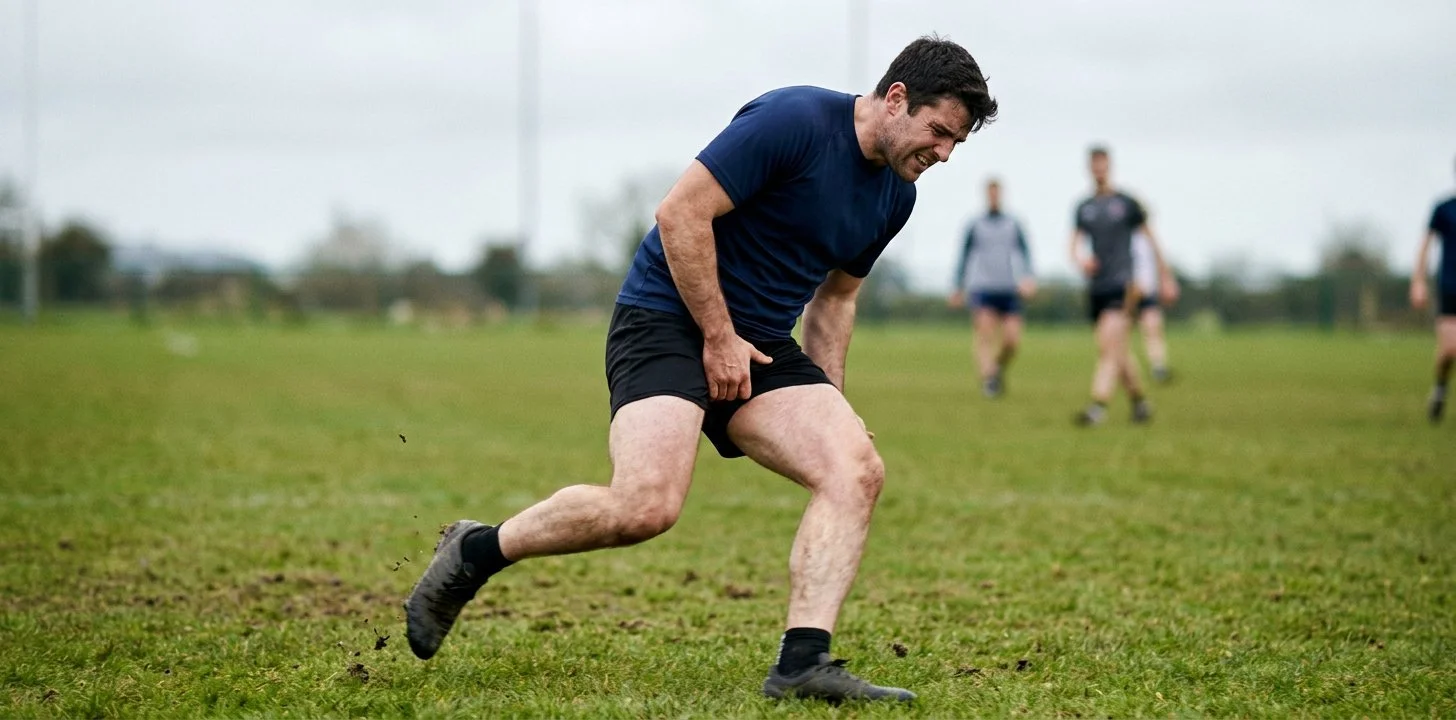
Groin Strain Treatment: The Complete Guide for GAA and Field Sport Players
The groin strain is one of the most common injuries in Gaelic games and field sports generally, driven by the repeated sprinting, cutting and kicking that these sports demand. It is also one of the injuries most prone to becoming a recurring, nagging problem rather than a single clean injury and recovery.
This guide covers what a groin strain actually involves, why it recurs so often in GAA specifically, and the treatment approach that produces a durable recovery rather than a temporary one.
What a Groin Strain Actually Is
The groin region contains several muscles, most commonly involved being the adductor group on the inner thigh, which pulls the leg inward and stabilises the hip during single-leg loading such as sprinting and cutting.
A strain occurs when these muscles or their tendons are loaded beyond their capacity, typically during a sudden forceful movement such as a sharp change of direction, an explosive sprint start, or a strong kicking action. This produces a spectrum of injury from a mild overstretch through to a significant tear, graded in a similar system to hamstring strains.
GAA in particular combines several of the specific demands that predispose to groin strain: repeated sprinting, sharp cutting movements, kicking with both feet, and sudden acceleration and deceleration, often on a wide pitch that encourages long sprints followed by rapid direction changes.
Why Groin Strains Recur So Often
This is the pattern we see most consistently in clinic, and understanding it changes how the injury should be managed.
Adductor strength relative to the opposing hip abductor muscles matters enormously. Research has consistently identified a relative weakness in the adductor muscles compared to the abductors as a significant risk factor for groin injury, and this imbalance is frequently still present after symptoms have settled, because pain resolution and strength recovery are not the same thing.
Symptoms often settle faster than the underlying tissue and strength deficit resolve. A player who feels comfortable walking and jogging within a couple of weeks often assumes the injury has healed, when the adductor is still considerably weaker than before the injury and not ready for the explosive sprinting and cutting that GAA demands.
Returning to full training and matches before strength has been objectively confirmed. Similar to the pattern seen in hamstring strains, covered in our guide on hamstring strain return to play, groin strains recur predominantly because return happens based on how the player feels rather than on measured readiness.
Inadequate off-season and pre-season strengthening. Groin injury incidence in GAA shows a clear seasonal pattern, often clustering around the return to intense training after a period of reduced activity, which points toward insufficient base strength going into the demanding phase of the season.

Treatment Phase by Phase
Phase 1: acute management. Reducing pain and protecting the injured tissue in the first few days. Avoiding movements that reproduce sharp pain, particularly forceful adduction and rapid changes of direction, while maintaining gentle movement within a comfortable range.
Phase 2: restoring pain-free movement and beginning loading. Progressive introduction of isometric adductor squeezes, which load the muscle without movement and are generally well tolerated even when the area remains irritable. Walking progresses toward light jogging as symptoms allow.
Phase 3: progressive strengthening, addressing the adductor to abductor balance specifically. This is the phase that most determines whether a player avoids recurrence. Copenhagen adduction exercises, a specific eccentric adductor exercise with strong supporting evidence in groin injury prevention research, are introduced and progressed systematically. Strengthening addresses both the adductors and the surrounding hip and core musculature, since groin strains frequently involve broader instability rather than an isolated muscle issue.
Phase 4: sport-specific return. Progressive reintroduction of sprinting, cutting and kicking, building from straight-line running through to the sharp changes of direction and explosive movements GAA demands, at controlled intensity before full training and match return.
At our clinic in Drogheda we use VALD Forcedecks testing to objectively measure adductor strength and the balance between adductors and abductors, which gives a considerably clearer picture of readiness than symptom reporting alone.
Prevention: What Actually Reduces Groin Injury Risk
Regular adductor strengthening as part of standard training, not just after an injury. The Copenhagen adduction exercise specifically has strong evidence supporting its role in reducing groin injury incidence when performed as a regular part of a squad’s training programme, not only in rehabilitation.
Addressing the adductor to abductor strength ratio. Balanced strength between these opposing muscle groups is more protective than adductor strength in isolation.
Adequate pre-season preparation. Given the seasonal clustering of groin injuries around the return to intense training, building strength progressively during pre-season rather than jumping straight into full-intensity training reduces risk meaningfully.
Proper warm-up including dynamic movements that prepare the adductors specifically. Generic warm-ups that do not include lateral movement and controlled adduction preparation leave this muscle group relatively unprepared for the sport’s demands.
Managing overall training load. As with most soft tissue injuries, sudden spikes in training volume or intensity increase risk. Gradual, planned progression is protective.

When to Seek Assessment
Some presentations warrant prompt professional assessment rather than self-management.
Significant pain immediately after injury that limits walking. Pain accompanied by swelling or bruising in the groin or inner thigh. Any pain that has persisted beyond two to three weeks despite sensible self-management. Recurrent groin strains, since this pattern specifically indicates that an underlying strength deficit or imbalance has not been adequately addressed. Groin pain that develops gradually without a specific injury moment, since this pattern sometimes indicates a different underlying issue requiring a different assessment approach.
A proper assessment identifies exactly which structures are involved, since the groin region contains several different muscles and tendons that can each be the primary source of a strain, and confirms the strength deficits that need to be specifically addressed in rehabilitation.
Book an assessment at our clinic in Drogheda if you have a current groin strain or a pattern of recurrent groin injuries that previous management has not resolved.
For related reading, see our guide on hamstring strain return to play, which shares much of the same underlying principle around premature return being the primary driver of recurrence, and our GAA injuries page for our broader approach to Gaelic games injuries.
Research on adductor strengthening and groin injury prevention is published in the British Journal of Sports Medicine.
Frequently Asked Questions
It depends on severity. Mild strains often allow a return to light training within one to two weeks, while more significant strains can take four to eight weeks or longer. As with hamstring injuries, return should be based on meeting strength and functional criteria rather than a fixed timeline.
Most commonly because symptoms settle faster than the underlying adductor strength deficit resolves, and players return to full training and matches before strength has been objectively confirmed to have recovered relative to the uninjured side.
The Copenhagen adduction exercise has strong supporting evidence for both rehabilitation and prevention when performed as a regular part of training, since it specifically targets the eccentric adductor strength that protects against this injury.
Complete rest is appropriate only in the acute phase immediately after injury. Beyond that, progressive controlled loading is generally more effective than prolonged rest, since the muscle needs appropriate stimulus to rebuild strength rather than simply being immobilised.
To a meaningful degree, yes. Regular adductor strengthening including exercises like the Copenhagen adduction, addressing the balance between adductor and abductor strength, adequate pre-season preparation, and sensible training load management all reduce risk.