
Physio Performance, Health & Fitness
Symptoms of Rotator Cuff Injury: How to Know if You Have One
The symptoms of rotator cuff injury are distinctive enough to recognise once you know the pattern, but they overlap sufficiently with frozen shoulder, shoulder impingement and referred neck pain that self-diagnosis frequently goes wrong.
That matters because the treatment for each is different. Weeks spent doing frozen shoulder mobility work on a rotator cuff tendinopathy, or resting a cuff that needs loading, are weeks lost.
This guide covers the classic symptom pattern, the specific findings that point toward the rotator cuff, and the symptoms that suggest something else entirely.
The Classic Symptom Pattern
Pain on the outer upper arm rather than deep in the joint. This surprises people. Rotator cuff pain is typically felt over the outer aspect of the upper arm, often around where a shirt sleeve ends, rather than at the point of the shoulder. Pain located deep in the front of the joint or across the top points elsewhere.
Pain on overhead movement. Reaching up to a high shelf, putting on a jacket, washing hair, or hanging out laundry. These are the movements patients consistently describe first.
Pain in a specific arc of movement. A characteristic finding is pain appearing as the arm is raised out to the side through roughly sixty to one hundred and twenty degrees, then easing again as the arm continues higher. This painful arc is a useful indicator.
Weakness rather than stiffness. This is the key distinction from frozen shoulder. With a rotator cuff problem, someone else can usually move your arm through a fuller range than you can move it yourself. With frozen shoulder, the range is restricted regardless of who is moving it.
Night pain, particularly lying on that side. Extremely common and often the symptom that finally prompts people to seek help.
Difficulty with specific everyday tasks. Reaching behind to a back pocket, fastening a bra strap, reaching into the back seat of a car, or lifting a kettle with an extended arm.

What Distinguishes Rotator Cuff From Frozen Shoulder
This is the most common diagnostic confusion in shoulder presentations, so it is worth setting out clearly.
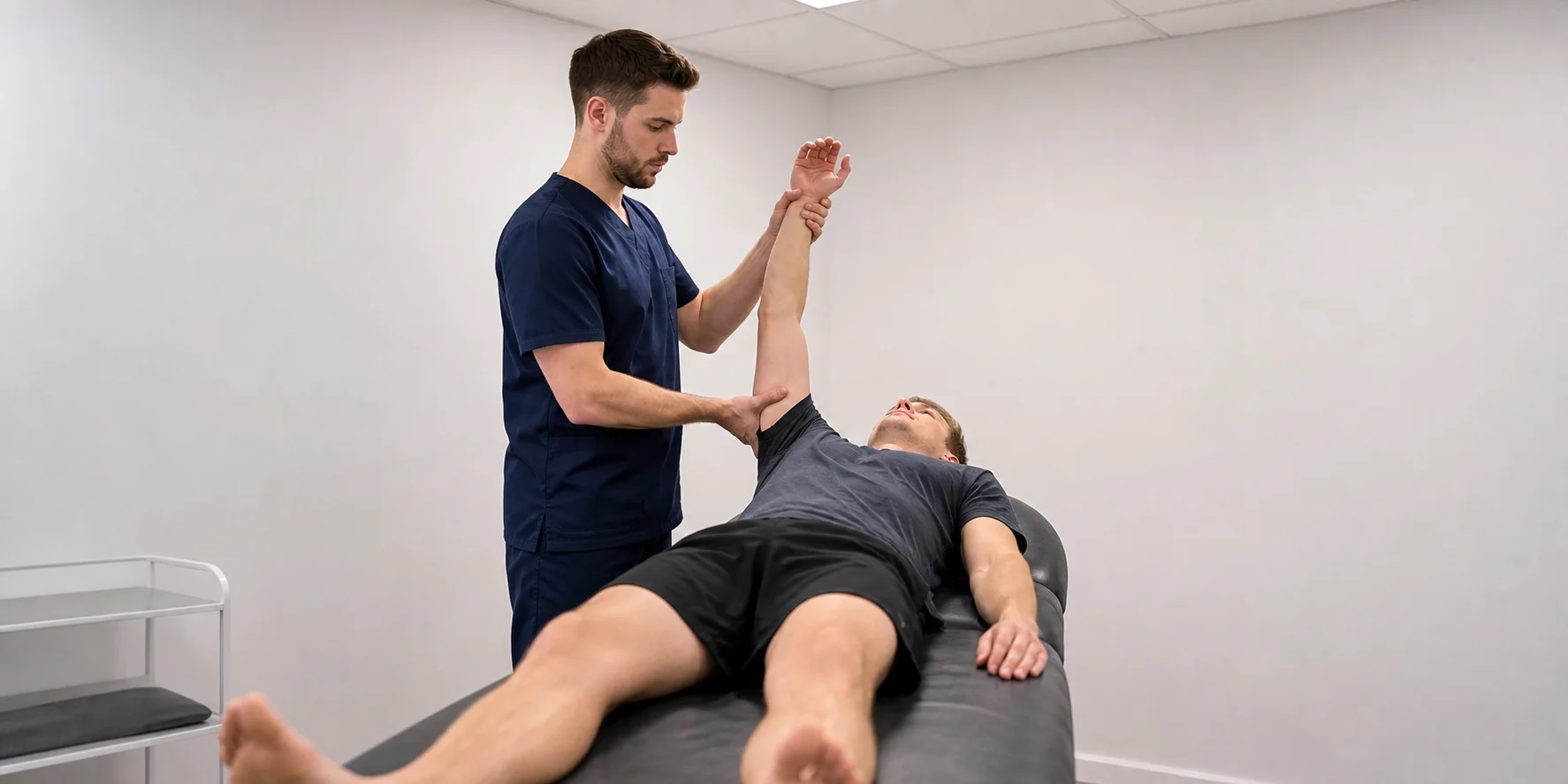
Rotator cuff injury. Active movement is limited by pain and weakness, but if a clinician passively moves the arm the range is considerably better. Pain is often position-specific rather than present through the whole range. Strength testing reproduces the pain and shows measurable weakness.
Frozen shoulder. Both active and passive movement are restricted to a similar degree. The clinician cannot move the arm further than the patient can. External rotation, turning the forearm outward with the elbow at the side, is characteristically the most restricted direction and often severely so.
The passive movement test is the quickest practical distinction, and it is not something patients can reliably perform on themselves, which is one reason self-diagnosis so often goes wrong.
Our guide on frozen shoulder operations covers the frozen shoulder pathway if that turns out to be the more likely picture.
The Clinical Tests a Physiotherapist Uses
Painful arc assessment. Watching the arm raised slowly out to the side to identify whether pain appears in a specific mid-range band.
Empty can test. The arm held at ninety degrees, angled forward, thumb down, with downward pressure applied. Pain or weakness suggests supraspinatus involvement.
Resisted external rotation. Elbow at the side bent to ninety degrees, resisting outward rotation. Pain or weakness suggests infraspinatus and teres minor involvement.
Lift off test. The hand placed behind the back and lifted away from the body. Difficulty suggests subscapularis involvement.
Passive range comparison. Comparing what the patient can do actively against what the clinician can achieve passively, which distinguishes cuff involvement from capsular restriction.
Cervical spine screening. The neck refers pain to the shoulder and upper arm in patterns that closely mimic cuff pathology. Any competent shoulder assessment includes neck examination.
At our clinic in Drogheda we combine these clinical tests with objective strength measurement through VALD Forcedecks assessment, which quantifies the weakness rather than estimating it.

Symptoms That Point Somewhere Other Than the Rotator Cuff
Severe restriction in all directions including passive. This points strongly toward frozen shoulder rather than rotator cuff.
Pins and needles or numbness down the arm. Suggests nerve involvement, most commonly from the cervical spine.
Pain that changes with neck movement. Turning or tilting the head altering the shoulder symptoms indicates a cervical contribution.
Pain deep in the front of the joint. More suggestive of biceps tendon involvement or a labral issue than rotator cuff.
Sudden complete inability to lift the arm following a fall. This warrants prompt assessment as it may indicate a large acute tear.
Constant unremitting pain unrelated to position or activity. Rotator cuff pain is movement and position related. Constant pain warrants proper assessment.
Swelling, redness or feeling unwell. These are not features of rotator cuff injury and require medical assessment.
What to Do if the Symptoms Match
If the pattern in this guide matches what you are experiencing, the useful early steps are straightforward.
Stop sleeping on the affected side and support the arm with a pillow when lying on the other side. This addresses the night pain that drives much of the distress.
Modify rather than stop overhead activity. Reduce the height, reduce the load, or change the technique for a period, but keep the shoulder moving.
Begin gentle isometric strengthening. Pressing the forearm gently against a wall in outward rotation and holding for thirty seconds introduces load without movement, which is well tolerated even in irritable shoulders.
Avoid prolonged complete rest. It weakens the cuff and prolongs recovery.
Seek assessment if symptoms have not improved within three to four weeks, if there is significant weakness, or if night pain is disrupting sleep consistently. Book an assessment at our clinic in Drogheda, or download our free neck and shoulder pain report in the meantime.
For expected timelines, see our guide on how long a rotator cuff injury takes to heal. For a related presentation, our post on shoulder pain reaching overhead covers that specific complaint.
Evidence on shoulder assessment and the correlation between imaging and symptoms is published in the British Journal of Sports Medicine, and the Chartered Society of Physiotherapy publishes patient information on shoulder conditions.
Frequently Asked Questions
Typically pain on the outer upper arm during overhead reaching, difficulty with tasks like putting on a jacket or reaching a high shelf, and pain when lying on that side at night.
The clearest distinction is passive movement. With a rotator cuff problem someone else can move your arm through a fuller range than you can. With frozen shoulder the restriction is similar whether you or someone else moves it.
Pain commonly refers to the outer upper arm, roughly to where a shirt sleeve ends. Pain extending past the elbow, or accompanied by pins and needles or numbness, suggests nerve involvement rather than the cuff.
Not always noticeably. Tendinopathy may produce pain with minimal detectable weakness. Tears more commonly produce measurable weakness, particularly on resisted testing in specific directions.
You can check for a painful arc by slowly raising the arm out to the side, and you can compare strength between sides. What you cannot reliably do is distinguish cuff pathology from frozen shoulder or referred neck pain, which is where professional assessment adds value.
Related reading
Struggling with this? See our shoulder pain treatment in Drogheda.