
Physio Performance, Health & Fitness
Rotator Cuff Recovery: The Complete Physiotherapy Guide to Getting Back to Full Strength
Rotator cuff recovery is frequently misunderstood as a period of rest followed by a return to normal activity. That approach reliably produces a shoulder that is weaker than before, still painful, and prone to recurrence.
The rotator cuff recovers through progressive loading. The tendon needs mechanical stimulus to remodel, and the surrounding musculature needs strengthening to reduce the load falling on the injured tissue. This guide sets out the four-phase programme we use at our clinic in Drogheda, what each phase is for, and how to know when to progress.
Why Rest Alone Fails
The rotator cuff is a group of four muscles that stabilise the ball of the shoulder within its shallow socket. Their job is continuous. Every time you lift your arm, the cuff is working to keep the joint centred.
When those muscles weaken, the mechanics change. The ball of the shoulder shifts slightly upward during elevation, which increases compression on the very tendons that are already irritated. This is why a period of rest often produces short-term pain relief followed by a rapid return of symptoms on resuming activity. The pain settled but the mechanical problem got worse.
Progressive loading addresses both. It stimulates tendon adaptation and it restores the strength that keeps the joint mechanics correct. Research consistently supports structured exercise as first-line management for the large majority of rotator cuff presentations, as summarised in the British Journal of Sports Medicine.
Phase One: Settle the Irritability (Weeks One to Three)
The aim in this phase is not strengthening. It is reducing the tissue irritability enough that meaningful loading becomes possible.
Sleep position. Stop lying on the affected side. When lying on the other side, place a pillow under the affected arm so it is supported rather than hanging across the body. This single change frequently produces noticeable improvement in night pain within a few days.
Activity modification. Reduce overhead work, lower the weight of what you lift, and change technique where possible. The instruction is modify, not stop. Complete avoidance is counterproductive.
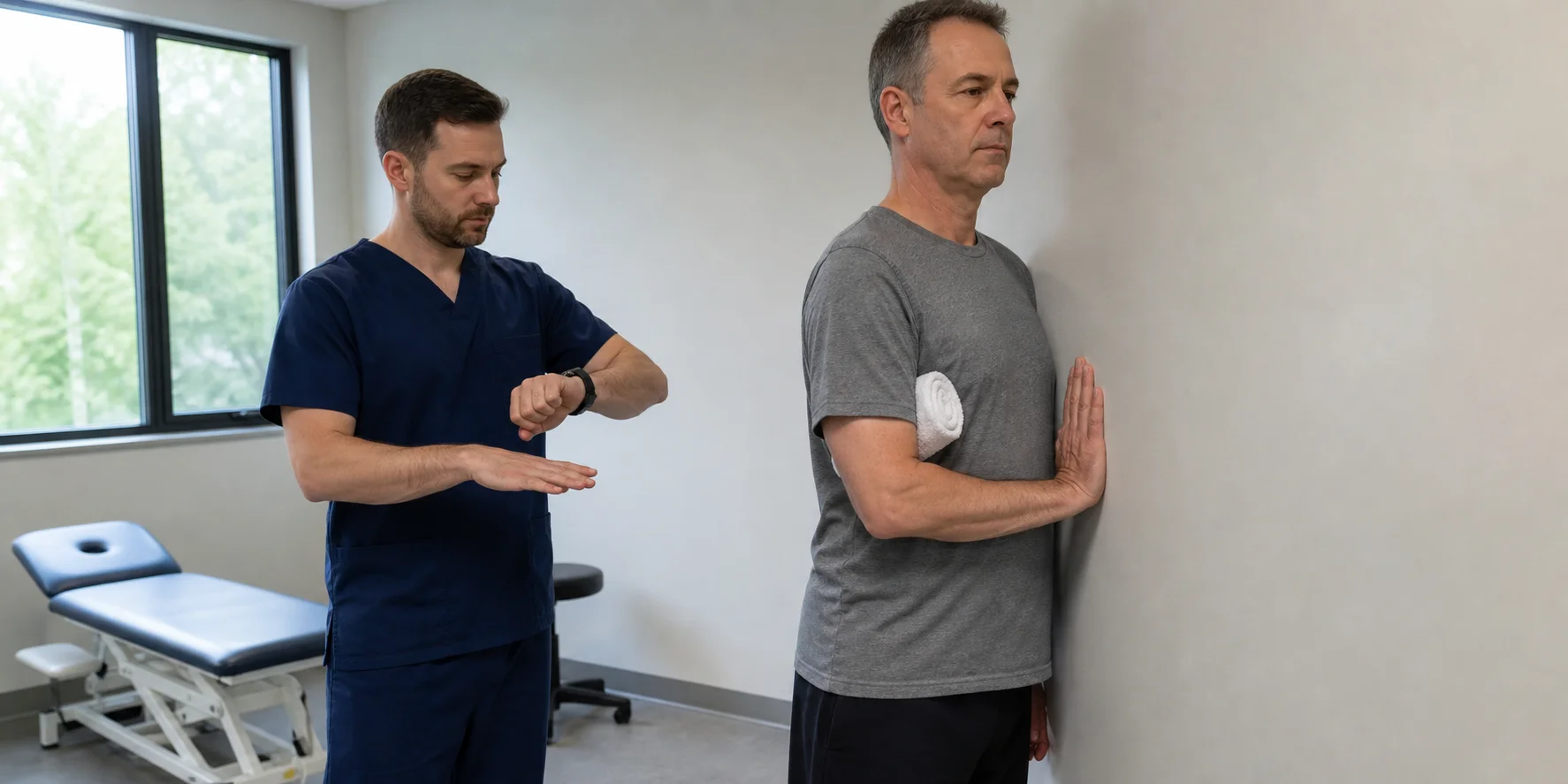
Isometric loading. Pressing the forearm gently against a wall in outward rotation and holding for thirty to forty seconds. Five holds, once or twice daily. Isometrics load the tendon without movement, which is well tolerated even in irritable shoulders and has a genuine pain-reducing effect.
Scapular setting. Gentle work on drawing the shoulder blade down and back, which begins addressing the postural component that contributes to most cuff presentations.
Progress out of this phase when night pain has reduced meaningfully and daily activities are manageable, typically at around two to three weeks.

Phase Two: Build Cuff Strength (Weeks Three to Eight)
This is where the actual correction happens and it is the phase most self-managed cases skip.
Resisted external rotation. With a resistance band anchored at elbow height, upper arm held against the side with a small rolled towel between elbow and ribs. Slow controlled rotation outward, slower return. Three sets of twelve to fifteen. This targets infraspinatus and teres minor, which are commonly the weakest.
Resisted internal rotation. The same setup, rotating inward. Targets subscapularis.
Scapular retraction rows. Band or cable rows with emphasis on drawing the shoulder blade back and down rather than simply pulling with the arms. Three sets of twelve.
Prone or bent-over horizontal abduction. Lying face down or bending forward, raising the arms out to the side. Targets the mid and lower trapezius and rhomboids, which control scapular position.
Progressive elevation work. Gradually reintroducing arm raising, initially below the painful arc, then progressively through it as tolerance improves.
The principle throughout is that mild discomfort during the exercise is acceptable, but pain that increases over subsequent sets or persists significantly the following day means the load was too high.
Throughout this phase we track progress objectively using VALD Forcedecks testing, which measures left to right strength differences rather than relying on how the shoulder feels on a given day.
Phase Three: Restore Function and Endurance (Weeks Eight to Fourteen)
Strength in isolation does not equal a functional shoulder. This phase bridges the gap.
Higher repetition endurance work. The rotator cuff is a postural stabiliser working continuously, so endurance matters as much as peak strength. Sets of twenty to thirty at lower resistance train this specifically.
Overhead loading. Progressive reintroduction of loaded overhead movement, starting with light weights in a partial range and building both load and range.
Combined movement patterns. Diagonal patterns that combine rotation with elevation, which reflect how the shoulder actually works during real tasks rather than in isolated planes.
Task-specific rehearsal. If the shoulder needs to lift boxes onto a shelf, paint a ceiling, or serve a tennis ball, that specific pattern needs to be rebuilt deliberately with graded load.

Phase Four: Return to Full Activity and Maintain
Progressive return to sport or work. For a manual worker this means graded return to full duties rather than a sudden resumption. For an overhead athlete it means a structured throwing or serving progression.
Maintenance strengthening. This is the phase most people skip and it is the primary reason rotator cuff problems recur. Two sessions per week of rotator cuff and scapular work, each taking around fifteen minutes, maintains the gains achieved through rehabilitation.
Ongoing load awareness. Sudden increases in overhead volume, whether at work, in the gym or in sport, are the most common trigger for recurrence. Progressive increases rather than abrupt ones.
What Slows Recovery Down
Skipping phase one. Attempting to strengthen an acutely irritable shoulder produces a flare and sets progress back.
Skipping phase two. Resting until pain settles and then returning to activity without strengthening is the single most common pattern in recurrent shoulder problems.
Inconsistency. Rotator cuff exercises performed twice a week produce meaningfully slower progress than the same exercises performed daily or near daily during the strengthening phase.
Loading too heavy too early. The cuff muscles are relatively small. Heavy resistance recruits the larger surrounding muscles instead, which means the cuff is not actually being trained. Lighter load with slow controlled tempo is more effective.
Ignoring the neck. Cervical spine contribution to shoulder symptoms is common. If neck involvement is present and untreated, the shoulder programme underperforms.
Not addressing sleep. Persistent night pain drives up overall pain sensitivity and undermines everything else.
When Recovery Is Not Progressing
If you have been working consistently through a loading programme for eight to ten weeks with no meaningful improvement, that warrants review rather than persistence.
The most common reasons are an inaccurate initial diagnosis, a significant structural tear that requires a different approach, an unaddressed cervical spine contribution, or a loading progression that is either too aggressive or too conservative.
For persistent tendinopathy that has not responded to loading alone, our shockwave therapy service has reasonable supporting evidence and can help unlock a stalled recovery. Our dry needling service can also assist where surrounding muscular tension is limiting progress.
Book an assessment at our clinic in Drogheda for a structured review, or download our free neck and shoulder pain report.
For expected timelines by injury type, see our guide on how long a rotator cuff injury takes to heal. To confirm whether your symptoms actually indicate a cuff problem, see our guide to the symptoms of rotator cuff injury.
The Chartered Society of Physiotherapy publishes patient guidance on shoulder rehabilitation.
Frequently Asked Questions
A full programme typically runs twelve to sixteen weeks from initial settling through to unrestricted activity. Tendinopathy addressed early can resolve in six to twelve weeks. Post-surgical recovery runs six to twelve months.
Resisted external and internal rotation with the elbow held at the side are the core exercises, supported by scapular retraction work and progressive overhead loading. Isometric holds are used in the early irritable phase.
Mild discomfort during the exercise is acceptable. Pain that increases across sets, or that persists significantly into the next day, indicates the load was too high and should be reduced rather than pushed through.
Yes, with modification. Heavy overhead pressing should be paused during the early phases, but most other lifting can continue at reduced load. Complete gym avoidance is rarely necessary and usually counterproductive.
Recurrence is common in people who stop their strengthening once pain resolves. Maintaining two brief sessions per week alongside sensible load progression substantially reduces that risk.
Related reading
Struggling with this? See our shoulder pain treatment in Drogheda.