
Physio Performance, Health & Fitness
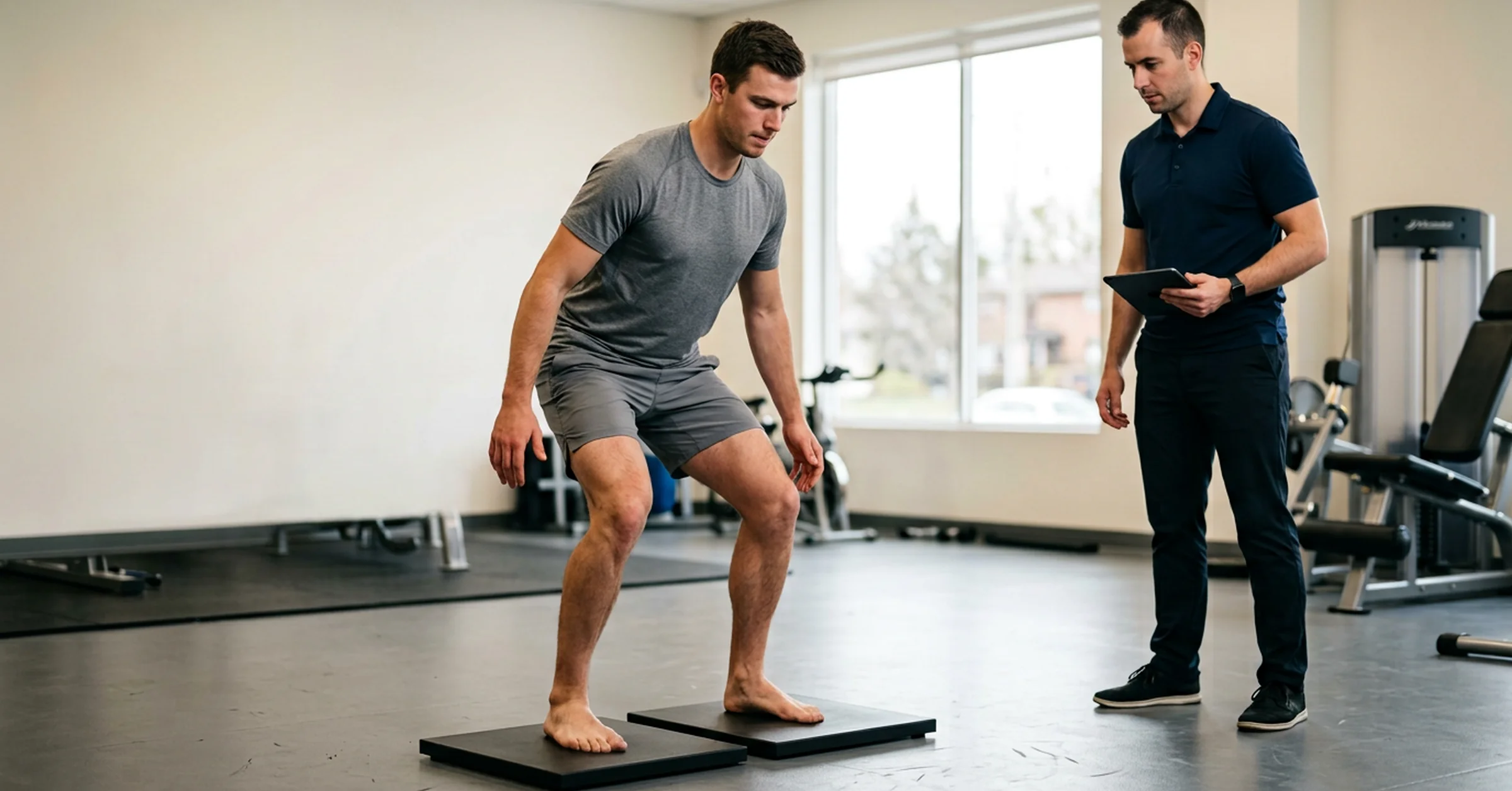
VALD Force Plate Testing: What It Actually Measures
Watching a patient move gives a physiotherapist useful information, but it doesn’t tell you exactly how much force their injured leg is producing compared to the uninjured one, down to the newton. VALD force plate testing, using the Forcedecks system, gives us that objective data directly, and it’s changed how we make return to sport decisions at our clinic in Drogheda.
This guide covers what the technology actually measures, and why it matters more than it might initially seem.
Why Visual Assessment Alone Has Limits
A physiotherapist’s trained eye is genuinely valuable, but it has a ceiling. Watching someone jump or land can identify obvious compensation patterns, but it can’t reliably detect a fifteen percent strength deficit between legs that looks visually similar to a fully recovered limb.
Perceived readiness and actual physical readiness frequently don’t match. Patients recovering from injury commonly feel ready to return to sport before their injured limb has actually regained equivalent strength and force production, and relying on how something feels risks a premature return.
This gap is one of the most consistent drivers of reinjury, particularly in hamstring, ACL and other significant lower limb injuries, where returning before genuine strength symmetry has been restored measurably increases the risk of a repeat injury.
What Forcedecks Testing Actually Measures
Force production during a jump, measured precisely for each leg independently. The plates capture exactly how much force each leg generates and how quickly, during tests like a countermovement jump or a single leg hop, producing numbers rather than an impression.
Asymmetry between the injured and uninjured side, expressed as a clear percentage. Rather than a general sense that one side “looks a bit weaker,” the system quantifies the exact difference, which is considerably more useful for tracking genuine progress over time.
Landing mechanics and force absorption. Beyond how much force a limb can produce, the system also captures how well it absorbs force on landing, which relates directly to injury risk during the deceleration movements common in most sports.
Rate of force development, not just peak force. How quickly a muscle can produce force matters enormously in sport, where most actions happen in a fraction of a second, and this is a dimension visual assessment simply cannot capture.

How We Actually Use This in Practice
Establishing a genuine baseline early in rehabilitation. Testing early in a recovery process gives us an objective starting point to measure progress against, rather than relying purely on subjective symptom reporting.
Tracking progress through rehabilitation with real numbers. Repeated testing at key stages shows whether strength and force production are genuinely improving, and by how much, rather than assuming progress based on time elapsed alone.
Making return to sport decisions based on data, not just how a patient feels. This is where Forcedecks testing has the most direct impact on outcomes, since a patient can be technically pain-free and still carry a meaningful strength deficit that visual assessment alone would miss entirely.
Identifying asymmetries before they become injuries. For athletes without a current injury, baseline testing can flag existing imbalances that increase future injury risk, allowing targeted strengthening work before a problem actually develops.
Who Benefits Most From This Testing
Athletes returning from significant lower limb injuries, particularly hamstring strains, ACL reconstructions and other injuries where asymmetry is a known driver of recurrence.
Athletes in a structured strength and conditioning programme wanting objective tracking of how their training is actually translating into force production and symmetry over time.
Anyone who wants genuine confidence, rather than a guess, before returning to competitive sport after any significant injury.

We use VALD Forcedecks testing as a core part of our return to sport process for patients recovering from significant injury, and it’s referenced throughout our guides on hamstring strain return to play and groin strain treatment, where objective strength testing directly informs return timing.
If you’re recovering from an injury and want an objective assessment of your readiness rather than a guess, book an assessment at our clinic in Drogheda.
Frequently Asked Questions
A force plate system that objectively measures force production, asymmetry between limbs, and landing mechanics during specific jump and hop tests, giving physiotherapists precise data rather than a visual impression alone.
Because perceived readiness and actual physical readiness frequently don’t match, and a strength deficit invisible to visual assessment is one of the most consistent drivers of reinjury when someone returns to sport too early.
No. It’s genuinely useful for anyone recovering from a significant injury who wants an objective measure of their strength and readiness, regardless of competitive level.
It adds precise, quantified data, exact force numbers and asymmetry percentages, on top of the clinical judgement and movement assessment a standard physiotherapy evaluation already provides.
This varies by injury and individual progress, but testing at key milestones, such as early baseline, mid-rehabilitation and pre-return to sport, gives a clear picture of genuine progress over time.